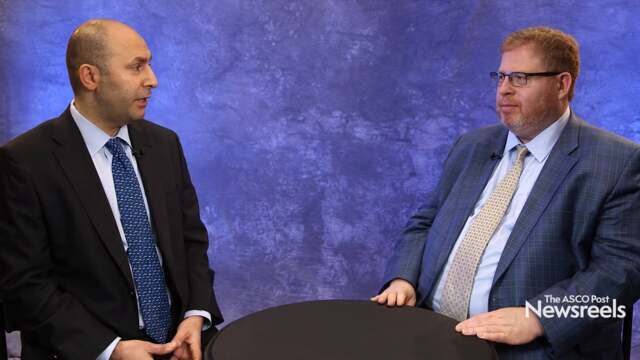
Joseph A. Sparano, MD, on Breast Cancer: Results of the TAILORx Trial
2018 ASCO Annual Meeting
Joseph A. Sparano, MD, of Montefiore Medical Center, discusses phase III study results on chemoendocrine treatment vs endocrine treatment alone in hormone receptor–positive, HER2-negative, node-negative breast cancer and an intermediate prognosis 21-gene recurrence score (Abstract LBA1).
Manisha H. Shah, MD, of The Ohio State University Comprehensive Cancer Center, summarizes a session she chaired on progress in tailored treatments for medullary and anaplastic thyroid cancers as well as salivary gland cancer.
Apostolia-Maria Tsimberidou, MD, PhD, of The University of Texas MD Anderson Cancer Center, discusses findings on clinical outcomes, including long-term survival, according to the pathway targeted and treatment period (Abstract LBA2553).
Laurie Helen Sehn, MD, MPH, of the British Columbia Cancer Centre for Lymphoid Cancer, discusses phase II study findings on polatuzumab vedotin with bendamustine and rituximab in relapsed or refractory follicular lymphoma and diffuse large B-cell lymphoma (Abstract 7507).
Peter Hillmen, MB, ChB, of St James’s University Hospital, discusses phase III study findings on minimal residual disease negativity with venetoclax plus rituximab in relapsed or refractory chronic lymphocytic leukemia (Abstract 7508).
Toni K. Choueiri, MD, of Dana-Farber Cancer Institute, and Jonathan E. Rosenberg, MD, of Memorial Sloan Kettering Cancer Center, discuss their perspectives on the top abstracts in bladder cancer presented at the 2018 ASCO Annual Meeting (Abstracts 4507, 4506, 4503, 4504).