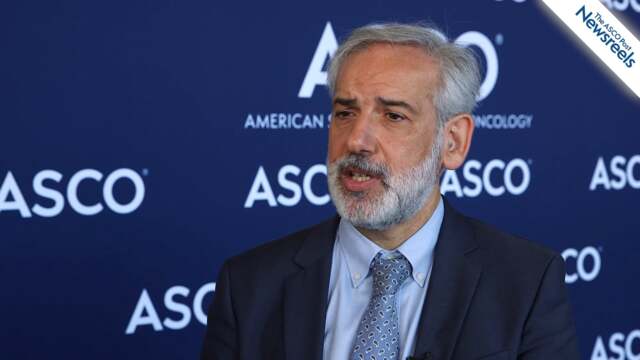
Andrew D. Seidman, MD, and Aditya Bardia, MD, MPH, on Metastatic Breast Cancer: Findings on an Antibody-Drug Conjugate
2018 ASCO Annual Meeting
Andrew D. Seidman, MD, of Memorial Sloan Kettering Cancer Center, and Aditya Bardia, MD, MPH, of Massachusetts General Hospital, discuss the efficacy of sacituzumab govitecan for treatment-refractory hormone receptor–positive/HER2-negative metastatic breast cancer (Abstract 1004).
Thierry Conroy, MD, of the Institut de Cancérologie de Lorraine, discusses phase III study findings on adjuvant mFOLFIRINOX vs gemcitabine in patients with resected pancreatic ductal adenocarcinomas (Abstract LBA4001).
Robert L. Coleman, MD, of The University of Texas MD Anderson Cancer Center, discusses phase III study findings on secondary surgical cytoreduction followed by platinum-based combination chemotherapy, with or without bevacizumab, in platinum-sensitive, recurrent ovarian cancer (Abstract 5501).
Michael Gnant, MD, of the Medical University of Vienna, discusses study findings on adjuvant denosumab in early breast cancer––a disease-free survival analysis of postmenopausal patients.
Meletios A. Dimopoulos, MD, of the National and Kapodistrian University of Athens, discusses phase III findings on ibrutinib/rituximab vs placebo/rituximab in Waldenström’s macroglobulinemia (Abstract 8003).
Gianni Bisogno, MD, of the University Hospital of Padova, discusses study findings on maintenance low-dose chemotherapy in patients with high-risk rhabdomyosarcoma (Abstract LBA2).