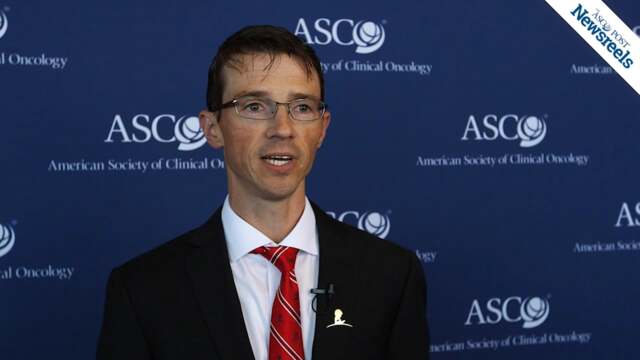
Rakesh Chopra, MD, on Global Health Care: Expert Perspective
2017 ASCO Annual Meeting
Rakesh Chopra, MD, of India’s Artemis Hospitals, discusses ASCO’s Role in global cancer care and the issues he finds most pressing.
Solange Peters, MD, PhD, of the University of Lausanne, who has been a driving force in ESMO’s efforts to promote women in oncology, talks with Mary Gospodarowicz, MD, of Princess Margaret Hospital, a recipient of the 2017 Women Who Conquer Cancer Mentorship Award.
Lisa A. Carey, MD, of the University of North Carolina, and Mark E. Robson, MD, of Memorial Sloan Kettering Cancer Center, discuss phase III study findings on olaparib monotherapy vs chemotherapy for patients with HER2-negative metastatic breast cancer and a germline BRCA mutation. (Abstract LBA4)
Ronald J. Buckanovich, MD, PhD, of the University of Michigan, discusses study findings on health-related quality of life with maintenance olaparib compared with placebo following chemotherapy in patients with germline BRCA-mutated platinum-sensitive relapsed serous ovarian cancer. (Abstract 5507)
Dean F. Bajorin, MD, of Memorial Sloan Kettering Cancer Center, and Peter H. O’Donnell, MD, of The University of Chicago Medical Center, discuss their study findings on treating advanced urothelial cancer with pembrolizumab, paclitaxel, docetaxel, or vinflunine. (Abstracts 4501 and 4502)
Todd M. Gibson, PhD, of St. Jude Children’s Research Hospital, discusses results from the Childhood Cancer Survivor Study, which showed a reduction in serious chronic morbidity measured across 3 decades. (LBA10500)