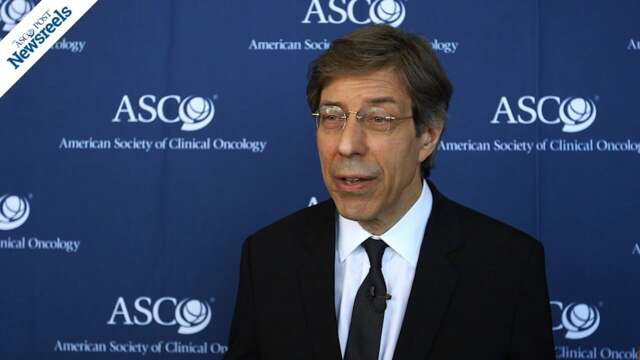
Julie Vose, MD, MBA, on DLBCL and FL: Expert Commentary on Two Studies
2017 ASCO Annual Meeting
Julie Vose, MD, MBA, of the University of Nebraska Medical Center, discusses two hematologic abstracts: results from the OPTIMAL>60 study on radiotherapy to bulky disease PET-negative after immunochemotherapy in elderly patients with diffuse large B-cell lymphoma; and an analysis of autologous vs matched sibling donor or matched unrelated donor allogeneic hematopoietic cell transplantation in follicular lymphoma patients with early chemoimmunotherapy failure. (Abstracts 7506, 7508)
Sumanta K. Pal, MD, of City of Hope, and Toni K. Choueiri, MD, of the Dana-Farber Cancer Institute, exchange views on the key papers in renal cell carcinoma presented at ASCO’s 2017 nonprostate GU oral abstract session. (Abstracts 4504, 4505, 4506, 4507, 4508)
Lisa A. Carey, MD, of the University of North Carolina, and Nadia Harbeck, MD, PhD, of Brustzentrum der Universität München, discuss study findings on adjuvant 4xEC→4x doc vs 6x docetaxel/cyclophosphamide in patients with high clinical risk and intermediate-to-high genomic risk HER2-negative, early breast cancer. (Abstract 504)
Axel Grothey, MD, of the Mayo Clinic Rochester, discusses study findings on shortening the duration of adjuvant oxaliplatin-based therapy, linked to neurotoxicity, for patients with stage III colon cancer. (Abstract LBA1)
David M. Hyman, MD, of Memorial Sloan Kettering Cancer Center, discusses findings on the efficacy of larotrectinib, a selective tropomyosin receptor kinase inhibitor, in adult and pediatric cancers. (Abstract LBA2501)
Gary Rodin, MD, of the University of Toronto, discusses study findings on a systematic approach to alleviating distress and managing predictable challenges. (Abstract LBA10001)