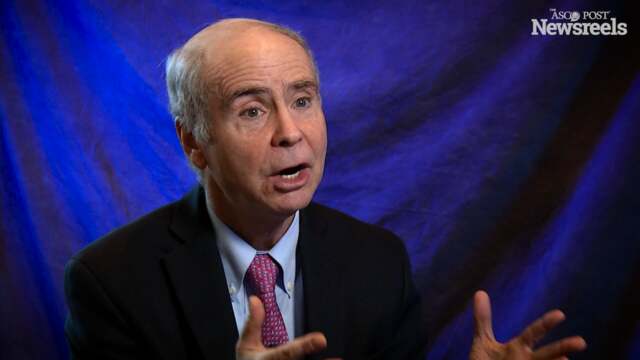
Christopher Willett, MD, on Localized Rectal Cancer: Emerging Treatment Paradigms
2016 NCCN Annual Conference (1)
Christopher Willett, MD, of Duke Cancer Center, discusses short and long courses of treatment, neoadjuvant chemotherapy with or without radiation, and organ preservation without surgery.
Douglas E. Wood, MD, of the University of Washington, discusses best practices, which enable a complete workup in 1 to 2 weeks in almost all patients, saving unnecessary testing.
Judith Paice, PhD, RN, of the Robert H. Lurie Comprehensive Cancer Center of Northwestern University, discusses strategies for safe opioid prescribing: making a comprehensive assessment, stratifying risk, using universal precautions, and educating practitioners on safe storage and disposal.
Sarah L. Blair, MD, of UC San Diego Moores Cancer Center, discusses surgical resection of breast cancer, which has the best chance of cure and is better than hormonal treatment alone, even in patients over age 80.
Toby C. Campbell, MD, of the University of Wisconsin Carbone Cancer Center, discusses palliative care, hospice care, and best supportive care practices, as well as the challenges of symptom management and end-of-life issues.
Kenneth Anderson, MD, of Dana-Farber Cancer Institute, discusses how the many advances in the treatment of multiple myeloma affect current and future clinical practice.