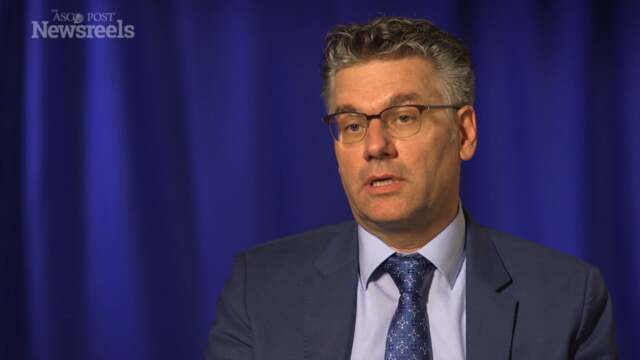
Omid Hamid, MD, on Melanoma: Results From the KEYNOTE-002 Study
2016 ESMO Congress
Omid Hamid, MD, of The Angeles Clinic and Research Institute, discusses survival data from this clinical trial on pembrolizumab vs investigator-choice chemotherapy for ipilimumab-refractory melanoma. (Abstract 1107O) Follow him on Twitter: @omidhamidmd
Katja Weisel, MD, of the University of Tübingen, discusses study findings on daratumumab, bortezomib, and dexamethasone vs bortezomib and dexamethasone in patients with relapsed or refractory multiple myeloma. (Abstract 906O)
Sian A. Pugh, MBBS, of Southampton University Hospital, discusses 6 to 12-year findings on the scheduled use of the CEA tumor marker and CT follow-up to detect recurrence of colorectal cancer. (Abstract 453O)
The ASCO Post
Teresa Calimeri, MD, PhD, of San Raffaele Hospital, discusses in Italian high-dose methotrexate as a CNS prophylaxis, shown to significantly improve outcome in patients with high-risk diffuse large B-cell lymphoma. (Abstract 908O)
Toni K. Choueiri, MD, of the Dana-Farber Cancer Institute, discusses study findings on cabozantinib vs sunitinib as initial targeted therapy for patients with metastatic renal cell carcinoma of poor and intermediate risk. (Abstract LBA30) Follow him on Twitter: @DrChoueiri
Christian U. Blank, MD, PhD, of the Netherlands Cancer Institute, discusses in German study findings on neoadjuvant ipilimumab plus nivolumab in patients with palpable stage III melanoma. (Abstract LBA39)