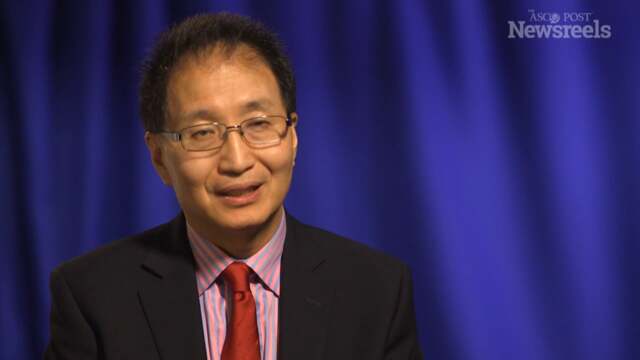
Christopher J. Sweeney, MBBS, on Localized Prostate Cancer: Metastasis-Free Survival as a Surrogate for Overall Survival
2016 ESMO Congress
Christopher J. Sweeney, MBBS, of the Dana-Farber Cancer Institute, discusses how this early clinical endpoint will accelerate the development of new therapies for localized intermediate and high-risk prostate cancer. (Abstract 717O)
Susana N. Banerjee, PhD, MBBS, of The Royal Marsden NHS Foundation Trust, discusses phase II findings on abiraterone in patients with recurrent epithelial ovarian cancer. (Abstract LBA33)
Martin H. Schuler, MD, of the University Hospital Essen, discusses in German findings from this phase II trial of epirubicin, oxaliplatin, and capecitabine with or without the antibody IMAB362 as first-line therapy in patients with advanced CLDN18.2+ disease. (Abstract 614O)
The ASCO Post
Teresa Calimeri, MD, PhD, of San Raffaele Hospital, discusses in Italian high-dose methotrexate as a CNS prophylaxis, shown to significantly improve outcome in patients with high-risk diffuse large B-cell lymphoma. (Abstract 908O)
Alain Ravaud, MD, PhD, of Bordeaux University Hospital, discusses in French phase III findings on sunitinib vs placebo as adjuvant treatment for high-risk renal cell carcinoma after nephrectomy. (Abstract LBA11)
Shou-Ching Tang, MD, PhD, of the Georgia Cancer Center, discusses findings on a novel peptide–paclitaxel conjugate that crosses the blood-brain barrier and shows activity in breast cancer patients with recurrent central nervous system metastases. (Abstract 324O)