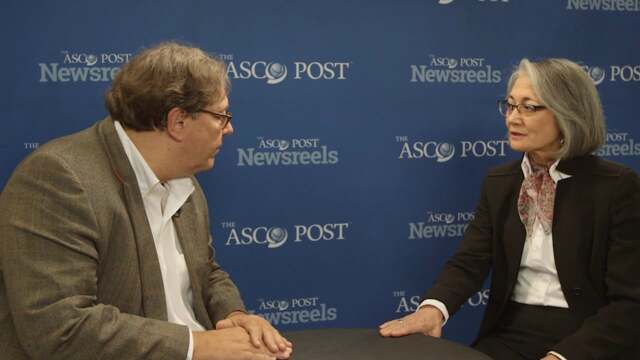
Maria Clemence Schwaederle, PharmD, on Precision Medicine: Its Impact in Refractory Malignancies
2016 ASCO Annual Meeting
Maria Clemence Schwaederle, PharmD, of the University of California, San Diego, discusses an analysis of 13,203 patients in phase I clinical trials, which showed that a personalized strategy led to improved response rate and progression-free survival (Abstract 11520).
Paul E. Goss, MD, PhD, of Massachusetts General Hospital Cancer Center and Harvard Medical School, discusses disease-free survival results from a study extending adjuvant letrozole for 5 years after completing an initial 5 years of aromatase inhibitor therapy alone or preceded by tamoxifen (Abstract LBA1).
Eric Roeland, MD, of the University of California, San Diego, and Linda Van Le, MD, of the University of North Carolina discuss ways to manage symptoms that affect up to 80% of postmenopausal women, diminishing their quality of life.
Julie Lemieux, MD, of Centre Hospitalier Universitaire de Québec, discusses in French patient-reported outcomes from a study extending adjuvant letrozole for 5 years after completing an initial 5 years of aromatase inhibitor therapy alone or preceded by tamoxifen (Abstract LBA506).

To see the English language version of this video, please
click here.
Sagar Lonial, MD, of Emory University School of Medicine, and Andrew D. Zelenetz, MD, PhD, of Memorial Sloan Kettering Cancer Center, discuss newly reported findings on rituximab maintenance therapy in hematologic malignancies (Abstracts 7503, 7504, and 7505).
A. Oliver Sartor, MD, of Tulane University, and Celestia S. Higano, MD, of the University of Washington, discuss findings from this phase III study on cabazitaxel vs docetaxel in chemotherapy-naive patients with metastatic castration-resistant prostate cancer (Abstract 5006).