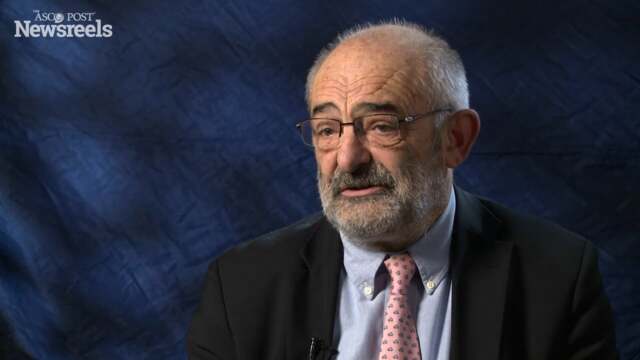
Jean-Charles Soria, MD, PhD, on Results of the Lux Lung 8 Clinical Trial
2015 European Cancer Congress
Jean-Charles Soria, MD, PhD, of Gustave Roussy, summarizes an important study: afatinib vs erlotinib in squamous cell carcinoma of the lung.
Cora N. Sternberg, MD
Cora N. Sternberg, MD, of San Camillo Forlanini Hospital, summarizes a teaching lecture on new targets in renal cell carcinoma, and discusses what to expect for the future of treating RCC.
Martine J. Piccart-Gebhart, MD, PhD
Martine J. Piccart-Gebhart, MD, PhD, of the Jules Bordet Institute, and ECCO President, discusses ways in which imaging can form the solution to individualized cancer treatment.
Federico Cappuzzo, MD, and Tony Mok, MD
Federico Cappuzzo, MD, of Istituto Toscano Tumori-Ospedale Civile Livorno, and Tony Mok, MD, of The Chinese University of Hong Kong, discuss current strategies for treating patients with acquired resistance, and what the future holds for these patients.
Clifford A. Hudis, MD
Clifford A. Hudis, MD, of Memorial Sloan Kettering Cancer Center, discusses this prospective study of endocrine therapy alone in patients with ER-positive, HER2-negative, node-negative breast cancer (Abstract 5BA).
Jean-Yves Douillard, MD, PhD
Jean-Yves Douillard, MD, PhD, of Centre R Gauducheau, reviews new clinical trials and data on systemic and radiation treatment of small cell lung cancer.