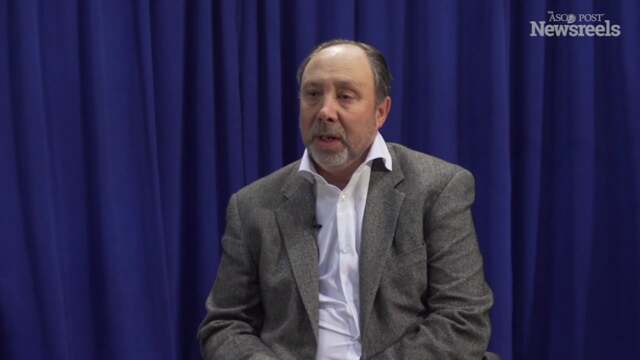
Andrew D. Zelenetz, MD, PhD, and Stephan Stilgenbauer, MD, PhD on CLL and Venetoclax: Clinical Trial Results
2015 ASH Annual Meeting
Andrew D. Zelenetz, MD, PhD, of Memorial Sloan Kettering Cancer Center, and Stephan Stilgenbauer, MD, PhD, of the University of Ulm, discuss this late-breaking abstract on venetoclax monotherapy and deep remissions in ultra-high risk relapsed/refractory chronic lymphocytic leukemia with 17p deletion (Abstract LBA6).
Mikkael A. Sekeres, MD
Mikkael A. Sekeres, MD, of the Cleveland Clinic, discusses an additional analysis of a phase II study of azacitidine combined with lenalidomide or with vorinostat vs azacitidine monotherapy in higher-risk myelodysplastic syndromes and chronic myelomonocytic leukemia (Abstract 908).
Olivier Casasnovas, MD
Olivier Casasnovas, MD, of Hôpital Le Bocage, discusses in French a phase III study comparing an early PET-driven treatment de-escalation to a not PET-monitored strategy in patients with advanced Hodgkin lymphoma (Abstract 577).
Stephen J. Schuster, MD
Stephen J. Schuster, MD, of the University of Pennsylvania, discusses the findings of a study of chimeric antigen receptor modified T cells directed against CD19 in patients with relapsed or refractory disease (Abstract 183).
Nathan Hale Fowler, MD
Nathan Hale Fowler, MD, of MD Anderson Cancer Center, discusses a multicenter trial in which ibrutinib plus rituximab was administered to treatment-naive patients with follicular lymphoma (Abstract 470).
Craig H. Moskowitz, MD
Craig H. Moskowitz, MD, of Memorial Sloan Kettering Cancer Center, discusses a phase I study of an anti-CD19 monoclonal antibody used in relapsed/refactory B-lineage non-Hodgkin lymphoma (Abstract 182).