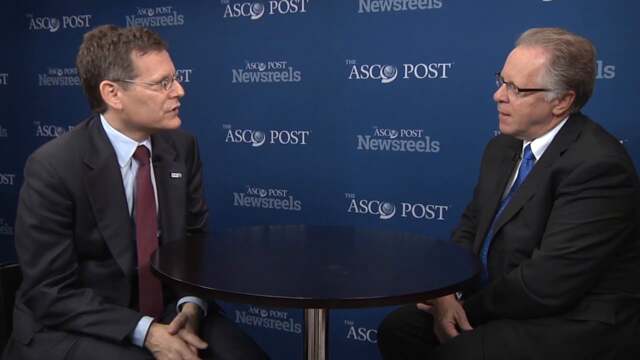
Andrew Zelenetz, MD, PhD
Andrew Zelenetz, MD, PhD, of Memorial Sloan Kettering Cancer Center, discusses two important lymphoma trials presented at ASCO and his views on whether their results are indeed practice-changing (Abstract 8504 and LBA8502).
Luis G. Paz-Ares, MD, PhD
Luis G. Paz-Ares, MD, PhD, of the Hospital Universitario Doce De Octubre, discusses the superior overall survival in patients taking nivolumab vs docetaxel in advanced nonsquamous NSCLC (Abstract LBA109).
David E. Gerber, MD, and James L. Mulshine, MD
James L. Mulshine, MD, of Rush University Medical Center, and David E. Gerber, MD, of The University of Texas Southwestern Medical Center, discuss the ALCHEMIST trial, an NCI initiative to address the role of molecular testing and targeted therapies for earlier-stage lung disease (Abstract TPS7583).
Howard M. Sandler, MD, and Christopher Sweeney, MBBS
Christopher Sweeney, MBBS, of Dana-Farber Cancer Institute, and Howard M. Sandler, MD, of Cedars-Sinai Medical Center, discuss the improvement of overall survival with the use of adjuvant chemotherapy following androgen suppression and radiotherapy (Abstract LBA5002).
Andrew D. Seidman, MD, and Clifford A. Hudis, MD
Clifford A. Hudis, MD, and Andrew D. Seidman, MD, of Memorial Sloan Kettering Cancer Center, discuss the use of the decision support system Watson for Oncology and results of the iCanCare study on second opinions (Abstracts 566 and 6508).