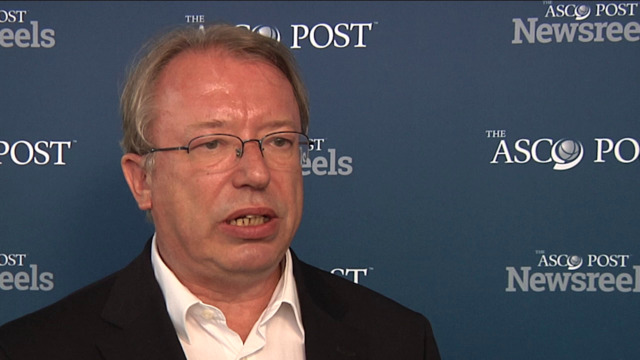
Patrick Schöffski, MD, on Eribulin for Soft-Tissue Sarcomas
2015 ASCO Annual Meeting
Patrick Schöffski, MD, of the University Hospital Leuven, discusses a phase III study in which he and his colleagues found, for the first time in soft-tissue sarcomas, a significant overall survival benefit of a single agent compared to a standard treatment (Abstract LBA10502).
Andrew Zelenetz, MD, PhD
Andrew Zelenetz, MD, PhD, of Memorial Sloan Kettering Cancer Center, discusses two important lymphoma trials presented at ASCO and his views on whether their results are indeed practice-changing (Abstract 8504 and LBA8502).
Gregory T. Armstrong, MD, MSCE
Gregory T. Armstrong, MD, MSCE, of St. Jude Children's Research Hospital, discusses the findings of a landmark survivorship study (Abstract LBA2).
Howard I. Scher, MD
Howard I. Scher, MD, of Memorial Sloan Kettering Cancer Center, discusses the updated criteria that will guide clinical trial design and conduct for therapeutics being tested in castration-resistant prostate cancer (Abstract 5000).
Julie Vose, MD, MBA
Julie Vose, MD, MBA, of the University of Nebraska Medical Center, reflects on the 2015 Annual Meeting and her year ahead as ASCO President.
Claus Garbe, MD
Claus Garbe, MD, of the University of Tuebingen, discusses the survival of sentinel lymph node biopsy–positive melanoma patients with and without complete lymph node dissection (Abstract LBA9002).