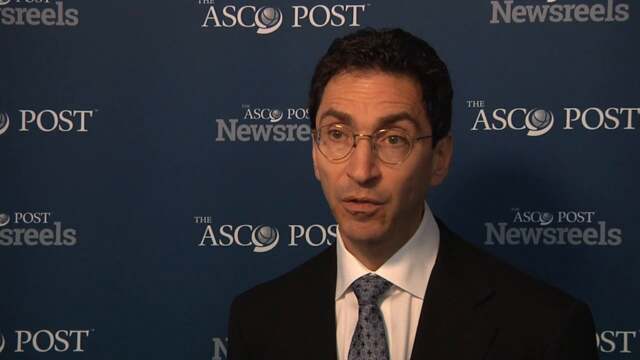
John Smyth, MD, on The Current State of Cancer Research and Treatment: The European Perspective
2015 ASCO Annual Meeting
John Smyth, MD, of the University of Edinburgh, discusses oncology from an international point of view.
Related Videos
Andrew James Martin, PhD, and Anthony J. Olszanski, RPh, MD
Andrew James Martin, PhD, of NHMRC Clinical Trials Centre, University of Sydney, and Anthony J. Olszanski, RPh, MD, of Fox Chase Cancer Center, discuss a form of vitamin B3 that reduced the incidence of new nonmelanoma skin cancers in high-risk patients (Abstract 9000).
Carolyn Jean Presley, MD, and James L. Mulshine, MD
James L. Mulshine, MD, of Rush University Medical Center, and Carolyn Jean Presley, MD, of Yale Cancer Center/Yale School of Medicine, discuss the burden on patients and the Medicare system as new lung cancer CT guidelines are put into effect and treatment of early-stage NSCLC increases (Abstract 7533).
Jedd Wolchok, MD, PhD, and Anthony J. Olszanski, RPh, MD
Anthony J. Olszanski, RPh, MD, of Fox Chase Cancer Center, and Jedd Wolchok, MD, PhD, of Memorial Sloan Kettering Cancer Center, discuss therapies for treatment-naive patients with advanced melanoma (Abstract LBA1).
Andrew D. Seidman, MD, and Clifford A. Hudis, MD
Clifford A. Hudis, MD, and Andrew D. Seidman, MD, of Memorial Sloan Kettering Cancer Center, discuss the use of the decision support system Watson for Oncology and results of the iCanCare study on second opinions (Abstracts 566 and 6508).
Leonard Saltz, MD
Leonard Saltz, MD, of Memorial Sloan Kettering Cancer Center, discusses how the cost of care affects behavior and decision-making on the part of patients and oncologists.