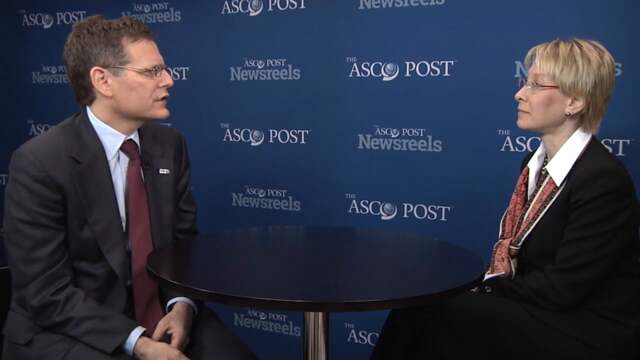
Gregory T. Armstrong, MD, MSCE, and Lisa Diller, MD, on Reduction of Late Mortality in Childhood Cancer Survivors
2015 ASCO Annual Meeting
Lisa Diller, MD, of Dana-Farber Cancer Institute, and Gregory T. Armstrong, MD, MSCE, of St. Jude Children's Research Hospital, discuss the findings of a landmark survivorship study (Abstract LBA2).
Leonard Saltz, MD
Leonard Saltz, MD, of Memorial Sloan Kettering Cancer Center, discusses how the cost of care affects behavior and decision-making on the part of patients and oncologists.
Sagar Lonial, MD, and James O. Armitage, MD
James O. Armitage, MD, of the University of Nebraska Medical Center, and Sagar Lonial, MD, of Emory University School of Medicine, discuss results from two important studies that tested lenalidomide/dexamethasone with or without elotuzumab and daratumumab monotherapy (Abstracts 8508 and LBA8512).
Christopher Sweeney, MBBS
Christopher Sweeney, MBBS, of Dana-Farber Cancer Institute discusses the EnzaMet and EnzaRad study designs, eligibility requirements, and endpoints (Abstracts TPS5077 and TPS5078).
Thomas W. LeBlanc, MD, and Eric Roeland, MD, FAAHPM
Thomas W. LeBlanc, MD, of Duke University Medical Center, and Eric Roeland, MD, FAAHPM, of the University of California, San Diego Moores Cancer Center, discuss the use of palliative and hospice care for patients with solid tumors vs hematologic cancers and clinicians’ attitudes (Abstracts e20554 and 9524).
Maura N. Dickler, MD and Clifford A. Hudis, MD
Clifford A. Hudis, MD, and Maura N. Dickler, MD, of Memorial Sloan Kettering Cancer Center, discuss adding bevacizumab to letrozole as a first-line endocrine therapy for treatment of hormone receptor–positive advanced breast cancer (Abstract 501).