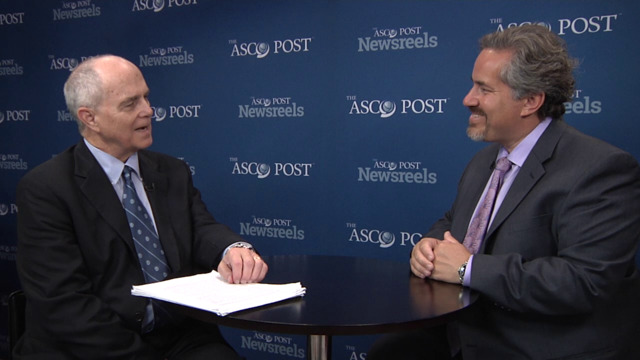
Christopher Sweeney, MBBS, Summarizes the ENZAMET and ENZARAD Trials for Prostate Cancer
2015 ASCO Annual Meeting
Christopher Sweeney, MBBS, of Dana-Farber Cancer Institute discusses the EnzaMet and EnzaRad study designs, eligibility requirements, and endpoints (Abstracts TPS5077 and TPS5078).
Jedd Wolchok, MD, PhD
Jedd Wolchok, MD, PhD, of Memorial Sloan Kettering Cancer Center discusses therapies for treatment-naive patients with advanced melanoma (Abstract LBA1).
Andrew James Martin, PhD
Andrew James Martin, PhD, of NHMRC Clinical Trials Centre, University of Sydney, discusses a form of vitamin B3 that reduced the incidence of new nonmelanoma skin cancers in high-risk patients (Abstract 9000).
Asher Alban Chanan-Khan, MD, and James O. Armitage, MD
James O. Armitage, MD, of the University of Nebraska Medical Center, and Asher Alban Akmal Chanan-Khan, MD, of the Mayo Clinic Cancer Center, discuss an important treatment option that significantly improved overall response rate and reduced risk of progression or death by 80% (Abstract LBA7005).
Anil D’Cruz, MD
Anil D’Cruz, MD, of Tata Memorial Hospital, discusses results from his study that seem to resolve a 50-year-long debate on performing elective neck dissection at the time of primary surgery––a potentially practice-changing finding (Abstract LBA3).
Ruben A. Mesa, MD, and James O. Armitage, MD
James O. Armitage, MD, of The University of Nebraska Medical Center, and Ruben A. Mesa, MD, of the Mayo Clinic, discuss pacritinib and its significant efficacy in myelofibrosis (Abstract LBA7006).