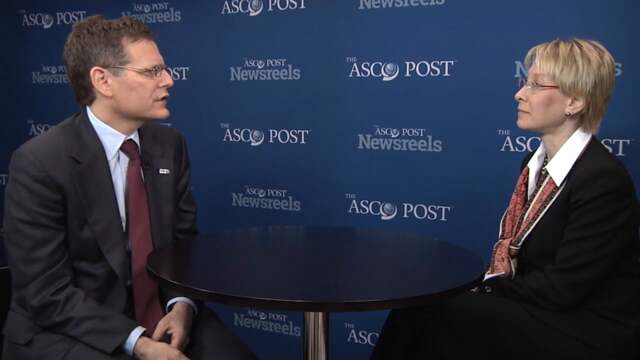
Andrew D. Seidman, MD, and Clifford A. Hudis, MD, on Breast Cancer Decision Analysis
2015 ASCO Annual Meeting
Clifford A. Hudis, MD, and Andrew D. Seidman, MD, of Memorial Sloan Kettering Cancer Center, discuss the use of the decision support system Watson for Oncology and results of the iCanCare study on second opinions (Abstracts 566 and 6508).
Leonard Saltz, MD
Leonard Saltz, MD, of Memorial Sloan Kettering Cancer Center, discusses how the cost of care affects behavior and decision-making on the part of patients and oncologists.
Chloe Evelyn Atreya, MD, PhD, and Axel Grothey, MD
Chloe Evelyn Atreya, MD, PhD, of the University of California, San Francisco, talks with Axel Grothey, MD, of the Mayo Clinic, about new data on trametinib, dabrafenib, and panitumumab in patients with the BRAF V600E mutation and vemurafenib plus irinotecan and cetuximab in BRAF-mutated metastatic colorectal cancer (Abstracts 103 and 3511).
Julie Vose, MD, MBA
Julie Vose, MD, MBA, of the University of Nebraska Medical Center, reflects on the 2015 Annual Meeting and her year ahead as ASCO President.
Jame Abraham, MD
Jame Abraham, MD, of the Cleveland Clinic discusses analyses of two trials for locally advanced, inflammatory, or early HER2-positive breast cancer using docetaxel, trastuzumab, pertuzumab, and neratinib (Abstracts 505 and 508).
Maura N. Dickler, MD and Clifford A. Hudis, MD
Clifford A. Hudis, MD, and Maura N. Dickler, MD, of Memorial Sloan Kettering Cancer Center, discuss adding bevacizumab to letrozole as a first-line endocrine therapy for treatment of hormone receptor–positive advanced breast cancer (Abstract 501).