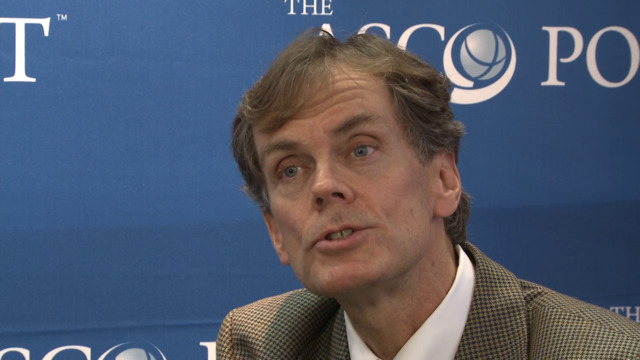
James O. Armitage, MD, FACP, FRCP, and Richard M. Stone, MD, on Progress Made Against AML and APL
2014 ASH Annual Meeting
James. O Armitage, MD, FACP, FRCP, of the University of Nebraska Medical Center, and Richard M. Stone, MD, of the Dana-Farber Cancer Institute, discuss advances in treating acute myeloid leukemia and the acute promyelocytic leukema subtype.
Julie M. Vose, MD, MBA, FASCO
Julie M. Vose, MD, MBA, FASCO, of the University of Nebraska Medical Center, offers her thoughts on abstract 289, “Nivolumab in Patients With Relapsed or Refractory Hodgkin Lymphoma: Preliminary Safety, Efficacy, and Biomarker Results of a Phase I Study,” presented by Philippe Armand, MD, PhD.
Bertrand Coiffier, MD, PhD
Bertrand Coiffier, MD, PhD, of Centre Hospitalier Lyon-Sud, offers his thoughts on abstract 393, “R-CHOP With or Without Radiotherapy in Nonbulky Limited-Stage Diffuse Large B-Cell Lymphoma: Preliminary Results of the Prospective Randomized Phase III 02-03 Trial from the Lysa/Goelams Group,” presented by Thierry Lamy, MD, PhD.