Advertisement


Related Videos

Hematologic Malignancies

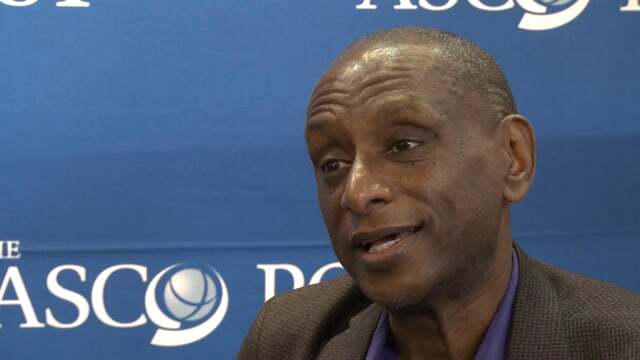
Keith McCrae, MD, on Managing Heparin-Induced Thrombocytopenia

Keith McCrae, MD, of the Cleveland Clinic, offers his thoughts on abstract 4848, “Implementation of a Heparin-Induced Thrombocytopenia Management Program Reduces the Cost of Diagnostic Testing and Pharmacologic Treatment in an Academic Medical Center,” presented by Caroline Dupre Vaughn, RN.

Lymphoma

Julie M. Vose, MD, MBA, FASCO, on Nivolumab in Relapsed/Refractory Hodgkin Lymphoma

Julie M. Vose, MD, MBA, FASCO, of the University of Nebraska Medical Center, offers her thoughts on abstract 289, “Nivolumab in Patients With Relapsed or Refractory Hodgkin Lymphoma: Preliminary Safety, Efficacy, and Biomarker Results of a Phase I Study,” presented by Philippe Armand, MD, PhD.

Hematologic Malignancies

Keith McCrae, MD, on Splenectomy in Immune Thrombocytopenia

Keith McCrae, MD, of the Cleveland Clinic, offers his thoughts on abstract 232, “Long-Term Complications After Splenectomy in Adult Chronic Immune Thrombocytopenia With a Minimum Follow-up of 10 Years: First Results From a Single-Center Case-Control Study in 140 Patients With Primary ITP,” presented by Lan-huong Thai.

Leukemia

Richard M. Stone, MD, on the SAL-SORAML Trial

Richard M. Stone, MD, of Dana-Farber Cancer Institute, offers his thoughts on abstract 6,  "Sorafenib vs Placebo in Addition to Standard Therapy in Younger Patients With Newly Diagnosed Acute Myeloid Leukemia: Results from 267 Patients Treated in the Randomized Placebo-Controlled SAL-Soraml Trial," presented by Christoph Röllig, MD.

Leukemia

James O. Armitage, MD, FACP, FRCP, and Hagop M. Kantarjian, MD, on Advances in the Treatment of ALL

James O. Armitage, MD, FACP, FRCP, of the University of Nebraska Medical Center, and Hagop M. Kantarjian, MD, of The University of Texas MD Anderson Cancer Center, discuss the diagnosis and genetics of ALL, differences in treating younger and older patients, and the latest data on the use of tyrosine kinase inhibitors, monoclonal antibodies, and CAR T cells.

Advertisement

Advertisement


Advertisement