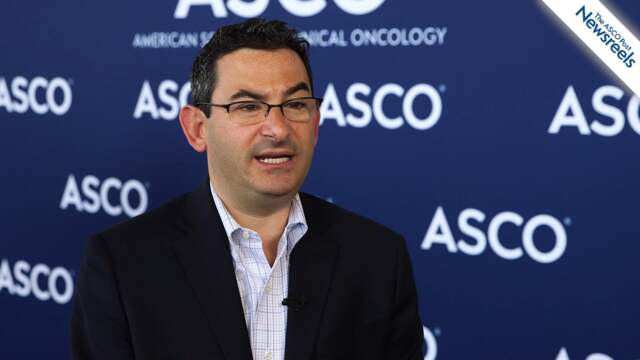
Arnaud Méjean, MD, PhD, on RCC: Results From the Carmena Trial
2018 ASCO Annual Meeting
Arnaud Méjean, MD, PhD, of the Hôpital Européen Georges Pompidou, discusses his study’s potentially practice-changing finding that nephrectomy is no longer the standard of care for patients with metastatic renal cell carcinoma (Abstract LBA3).
Rita Elias Assi, MD, of The University of Texas MD Anderson Cancer Center, discusses the impact of next-generation sequencing on treatment selection in acute myeloid leukemia (Abstract 103).
Sibylle Loibl, MD, PhD, of the German Breast Group, discusses phase II study findings on the addition of durvalumab to a taxane-anthracycline–containing chemotherapy in triple-negative breast cancer (Abstract 104).
Helena Margaret Earl, MBBS, PhD, of the University of Cambridge, discusses phase III study findings on 6 vs 12 months of adjuvant trastuzumab in patients with HER2-positive early breast cancer (Abstract 506).
Sherry Shen, MD, of Columbia University Medical Center, discusses findings on the use of omega-3 fatty acid for obese breast cancer patients with aromatase inhibitor–related arthralgia (Abstract 10000).
Jeremy S. Abramson, MD, of the Massachusetts General Hospital, discusses study findings on lisocabtagene maraleucel in relapsed or refractory aggressive NHL (Abstract 7505).