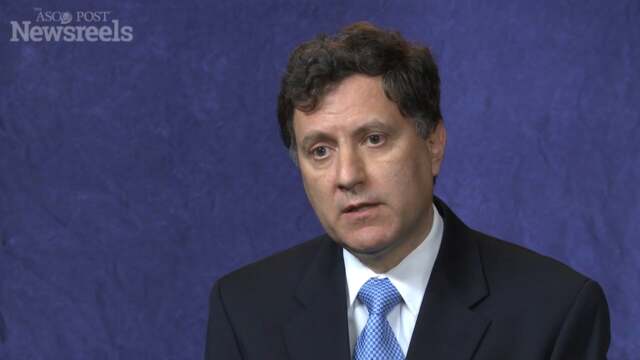
Ignacio Melero, MD, PhD, on Hepatocellular Carcinoma: Results of the CheckMate 040 Trial (Spanish Language Version) 
2017 Gastrointestinal Cancers Symposium
Ignacio Melero, MD, PhD, of the University Clinic of Navarra, Centre of Applied Medical Research, discusses in Spanish study findings on nivolumab dose escalation and expansion in patients with advanced hepatocellular carcinoma (Abstract 226).
Scott Kopetz, MD, of The University of Texas MD Anderson Cancer Center, discusses study findings on irinotecan and cetuximab with or without vemurafenib in BRAF-mutant metastatic colorectal cancer (Abstract 520).
Sarah E. Hoffe, MD, of the Moffitt Cancer Center, discusses the controversial role of radiation in the treatment of pancreatic cancer, recent advances in delivering short courses of high-dose stereotactic body radiation therapy, and how best to integrate this new modality in borderline and locally advanced disease.
Salah-Eddin Al-Batran, MD, of the Institute of Clinical Cancer Research and Nordwest Hospital, discusses study findings on paclitaxel with and without RAD001 in patients with gastric cancer whose disease has progressed after therapy with a fluoropyrimidine/platinum-containing regimen (Abstract 4).
Brendan J. Guercio, MD, of the Dana-Farber Cancer Institute, discusses results from a study of patients with metastatic colorectal cancer who took part in weekly physical activity and its impact on their disease progression and overall survival (Abstract 659).
Ignacio Melero, MD, PhD, of the University Clinic of Navarra, Centre of Applied Medical Research, discusses study findings on nivolumab dose escalation and expansion in patients with advanced hepatocellular carcinoma (Abstract 226).