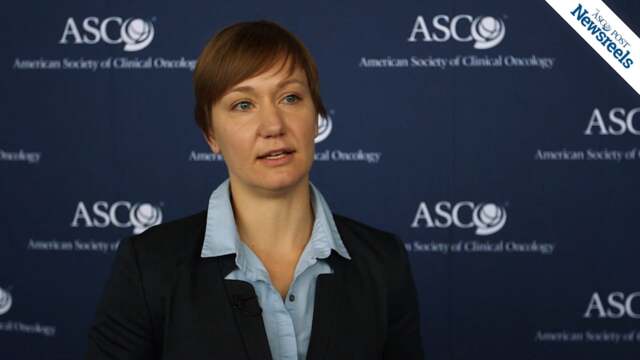
Matteo Lambertini, MD, on Pregnancy in Breast Cancer Patients: Results From a Multicenter Study
2017 ASCO Annual Meeting
Matteo Lambertini, MD, of the Institut Jules Bordet, discusses a long-term follow-up analysis of the safety of pregnancy in patients with a history of estrogen receptor–positive breast cancer. (Abstract LBA10066)
Ronald J. Buckanovich, MD, PhD, of the University of Michigan, discusses study findings on health-related quality of life with maintenance olaparib compared with placebo following chemotherapy in patients with germline BRCA-mutated platinum-sensitive relapsed serous ovarian cancer. (Abstract 5507)
Jame Abraham, MD, of the Cleveland Clinic, gives his views on findings on abemaciclib in combination with fulvestrant in patients with HR+/HER2- advanced breast cancer who progressed on endocrine therapy. (Abstract 1000)
Nicholas D. James, MBBS, PhD, of Queen Elizabeth Hospital, discusses study findings on adding abiraterone for men with high-risk prostate cancer starting long-term androgen-deprivation therapy (Abstract LBA5003).
Ann-Lii Cheng, MD, PhD, of the National Taiwan University Hospital, discusses phase III study findings on lenvatinib vs sorafenib in first-line treatment of patients with unresectable hepatocellular carcinoma. (Abstract 4001)
Erin Van Blarigan, ScD, of the University of California, San Francisco, discusses the value of lifestyle recommendations from the American Cancer Society for people who have been diagnosed with colon cancer, including longer disease-free and overall survival. (Abstract 10006)