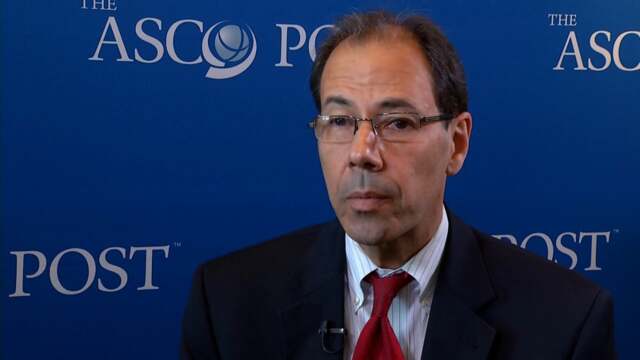
Melinda Telli, MD, on Evolving Treatment Strategies for Triple-Negative Breast Cancer
2015 NCCN Annual Conference
Melinda Telli, MD, of Stanford Cancer Institute, discusses the TNT trial for triple-negative breast cancer and the results reported at the San Antonio Breast Cancer Symposium.
Wui-Jin Koh, MD
Wui-Jin Koh, MD, of the Fred Hutchinson Cancer Research Center and the Seattle Cancer Care Alliance, discusses the program to adapt NCCN guidelines to regions of the world with different resource availability. The first guideline to be adapted in this way is for cervical cancer, which is prevalent in the developing world.
Hans Gerdes, MD
Hans Gerdes, MD, of Memorial Sloan Kettering Cancer Center, discusses a new approach to the management of early-stage esophageal cancers with endoscopic resections.
Mario E. Lacouture, MD
Mario E. Lacouture, MD, of Memorial Sloan Kettering Cancer Center, discusses the effect on patients of dermatologic toxicities associated with targeted therapies: their psychosocial impact, financial burden, physiological pain, and potential to alter therapy. But the side effects of targeted treatments can and should be addressed.
Mary Lou Smith, JD, MBA
Mary Lou Smith, JD, MBA, of the Research Advocacy Network, discusses, from the perspective of a patient advocate, the value of the NCCN guidelines and the impact they have made on cancer care.
Thomas A. D’Amico, MD
Thomas A. D’Amico, MD, of Duke Cancer Institute, discusses the superior efficacy of thoracoscopic lobectomy. This minimally invasive procedure is used in only 50% of lung cancer surgeries in the United States, in 30% of procedures in Asia, and in as few as 10% to 20% of procedures in Europe.