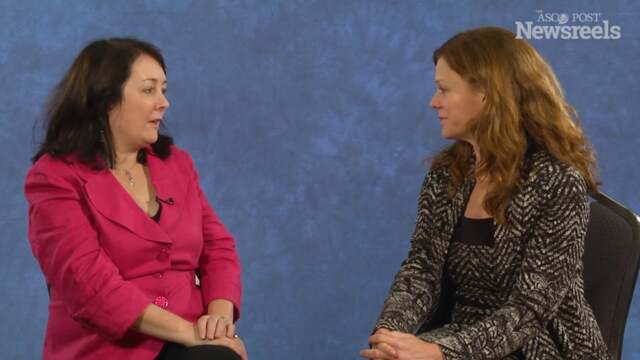
Virginia G. Kaklamani, MD, DSc, on Early Breast Cancer: Year in Review
2016 San Antonio Breast Cancer Symposium
Virginia G. Kaklamani, MD, DSc, of The University of Texas Health Science Center, discusses new directions in prevention, early detection, and treatment of early-stage breast cancer, using genomic tests and targeted therapies.
Stephen R.D. Johnston, MBBS, PhD, of The Royal Marsden NHS Foundation Trust, and Ann H. Partridge, MD, of the Dana-Farber Cancer Institute, discuss the role of endocrine therapy and optimal sequencing, recent progress in first-line treatment, and resistance pathways and second-line treatment (Plenary Lecture 1).
Monica Morrow, MD, of Memorial Sloan Kettering Cancer Center, recognized at this year’s meeting for scientific distinction in clinical research, summarizes her Brinker Award lecture on modifying local therapy to decrease the burden of cancer treatment.
Matthew P. Goetz, MD, of the Mayo Clinic, reviews progress made during the past year on treatment of advanced disease.
Ruth O'Regan, MD, of the University of Wisconsin, discusses study findings on buparlisib plus fulvestrant in postmenopausal women with HR-positive, HER2-positive, aromatase inhibitor–treated, locally advanced or metastatic breast cancer, who progressed on or after mTOR inhibitor–based treatment (Abstract S4-07).
Ruth O’Regan, MD, of the University of Wisconsin, and Ann H. Partridge, MD, of the Dana-Farber Cancer Institute, discuss study findings from a session Dr. O’Regan moderated on three major trials addressing anastrozole after tamoxifen in HR-positive early breast cancer, letrozole in HR-positive disease, and extended letrozole treatment after adjuvant endocrine therapy (Abstracts S1-03, S1-05, S1-08).