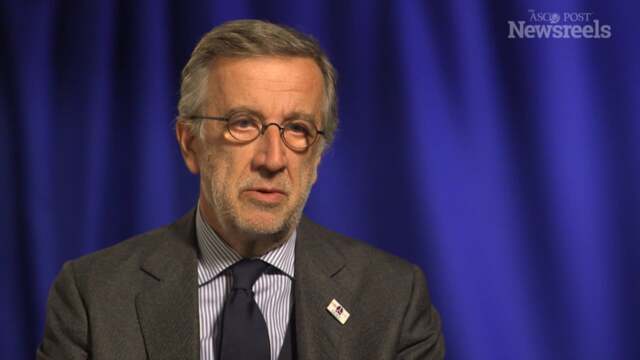
Tony Mok, MD, on NSCLC: Results of the IMPRESS Study
2016 ESMO Congress
Tony Mok, MD, of The Chinese University of Hong Kong, discusses the final overall survival analysis from this trial on gefitinib/chemotherapy vs chemotherapy in EGFR mutation-positive non-small cell lung cancer after progression on first-line gefitinib. (Abstr 1201O)
Sian A. Pugh, MBBS, of Southampton University Hospital, discusses 6 to 12-year findings on the scheduled use of the CEA tumor marker and CT follow-up to detect recurrence of colorectal cancer. (Abstract 453O)
Paolo A. Ascierto, MD, of the Istituto Nazionale Tumori–Fondazione Pascale, discusses in Italian overall survival and safety results from a phase 3 trial of ipilimumab at 3 mg/kg vs 10 mg/kg in patients with metastatic melanoma. (Abstract 1106O)
Philippe Rochigneux, MD, of the Paoli Calmettes Institute, Marseille Cancer Center, discusses in French his findings on the high rates of chemotherapy used at the end of life for metastatic solid cancer, especially in young patients treated in high-volume centers without a palliative care unit. (Abstract 1300O)
Christian U. Blank, MD, PhD, of the Netherlands Cancer Institute, discusses in German study findings on neoadjuvant ipilimumab plus nivolumab in patients with palpable stage III melanoma. (Abstract LBA39)
Giorgio V. Scagliotti, MD, PhD, of the University of Torino, discusses study findings on ceritinib vs chemotherapy in patients with advanced ALK-rearranged non-small cell lung cancer previously treated with chemotherapy and crizotinib. (Abstract LBA42)