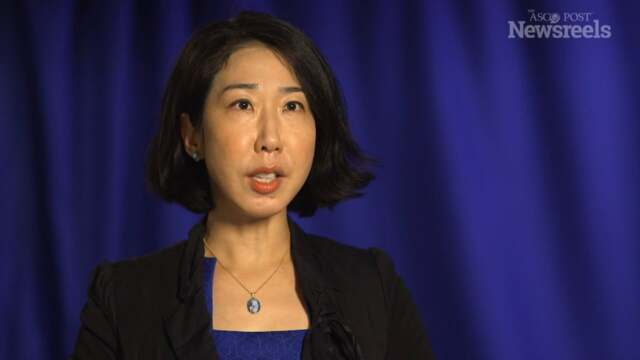
Teresa Calimeri, MD, PhD, on DLBCL: Findings on High-Dose Methotrexate (Italian Language Version) 
2016 ESMO Congress
Teresa Calimeri, MD, PhD, of San Raffaele Hospital, discusses in Italian high-dose methotrexate as a CNS prophylaxis, shown to significantly improve outcome in patients with high-risk diffuse large B-cell lymphoma. (Abstract 908O)
Omid Hamid, MD, of The Angeles Clinic and Research Institute, discusses survival data from this clinical trial on pembrolizumab vs investigator-choice chemotherapy for ipilimumab-refractory melanoma. (Abstract 1107O) Follow him on Twitter: @omidhamidmd
Alain Ravaud, MD, PhD, of Bordeaux University Hospital, discusses in French phase III findings on sunitinib vs placebo as adjuvant treatment for high-risk renal cell carcinoma after nephrectomy. (Abstract LBA11)
Luis G. Paz-Ares, MD, PhD, of the Hospital Universitario 12 De Octubre, discusses in Spanish overall survival data on afatinib vs gefitinib in patients with EGFR mutation–positive non–small cell lung cancer. (Abstract LBA43)
Philippe Rochigneux, MD, of the Paoli Calmettes Institute, Marseille Cancer Center, discusses his findings on the high rates of chemotherapy used at the end of life for metastatic solid cancer, especially in young patients treated in high-volume centers without a palliative care unit. (Abstract 1300O)
Jung-min Lee, MD, of the National Cancer Institute, discusses findings of a phase II study of the cell cycle checkpoint kinase inhibitors LY2606368 and prexasertib monomesylate monohydrate in sporadic high-grade serous and germline BRCA mutation-associated ovarian cancer. (Abstract 855O)