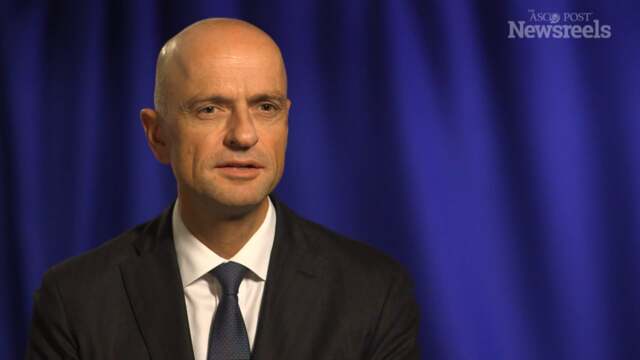
Sumanta K. Pal, MD, on Urothelial Cancer: Results From the CheckMate 275 Trial
2016 ESMO Congress
Sumanta K. Pal, MD, of the City of Hope, discusses phase II findings on the efficacy and safety of nivolumab monotherapy in patients with metastatic urothelial cancer who have received prior treatment. Follow him on Twitter: @montypal
Katja Weisel, MD, of the University of Tübingen, discusses in German study findings on daratumumab, bortezomib, and dexamethasone vs bortezomib and dexamethasone in patients with relapsed or refractory multiple myeloma. (Abstract 906O)
Philippe Rochigneux, MD, of the Paoli Calmettes Institute, Marseille Cancer Center, discusses his findings on the high rates of chemotherapy used at the end of life for metastatic solid cancer, especially in young patients treated in high-volume centers without a palliative care unit. (Abstract 1300O)
Martin H. Schuler, MD, of the University Hospital Essen, discusses in German findings from this phase II trial of epirubicin, oxaliplatin, and capecitabine with or without the antibody IMAB362 as first-line therapy in patients with advanced CLDN18.2+ disease. (Abstract 614O)
Fabrice Barlesi, MD, PhD, of Aix Marseille University and Assistance Publique Hopitaux De Marseille, discusses phase III findings on a comparison of atezolizumab with docetaxel in patients with advanced non-small cell lung cancer. (Abstract LBA44)
Martin H. Schuler, MD, of the University Hospital Essen, discusses findings from this phase II trial of epirubicin, oxaliplatin, and capecitabine with or without the antibody IMAB362 as first-line therapy in patients with advanced CLDN18.2+ disease. (Abstract 614O)