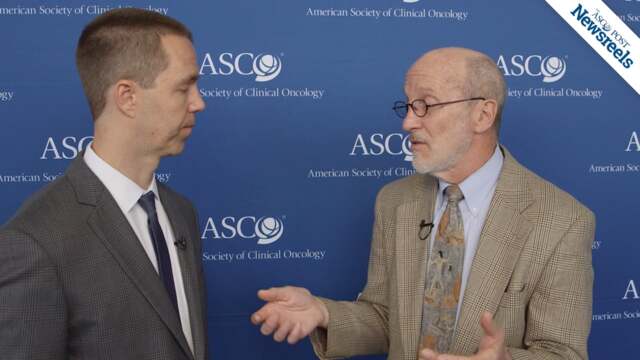
Sagar Lonial, MD, and Andrew Zelenetz, MD, PhD, on MCL, DLBCL, CLL: How Much Rituximab Is Enough?
2016 ASCO Annual Meeting
Sagar Lonial, MD, of Emory University School of Medicine, and Andrew D. Zelenetz, MD, PhD, of Memorial Sloan Kettering Cancer Center, discuss newly reported findings on rituximab maintenance therapy in hematologic malignancies (Abstracts 7503, 7504, and 7505).
Julie Lemieux, MD, of Centre Hospitalier Universitaire de Québec, discusses in French patient-reported outcomes from a study extending adjuvant letrozole for 5 years after completing an initial 5 years of aromatase inhibitor therapy alone or preceded by tamoxifen (Abstract LBA506).

To see the English language version of this video, please
click here.
The
Jonathan A. Ledermann, MD, of Cancer Research UK and University College London Cancer Trials Centre, and Ursula A. Matulonis, MD, of the Dana-Farber Cancer Institute, discuss findings on overall survival in patients with platinum-sensitive relapsed serous ovarian cancer receiving olaparib maintenance monotherapy (Abstract 5501).
The
Marcel Verheij, PhD, of the Netherlands Cancer Institute, and John Marshall, MD, of Georgetown University Lombardi Comprehensive Cancer Center, discuss findings from this multicenter phase III study of neoadjuvant chemotherapy followed by either surgery and chemotherapy or surgery and chemoradiotherapy in resectable gastric cancer (Abstract 4000).
Lisa A. Carey, MD, of the University of North Carolina, and Tuya Pal, MD, of H. Lee Moffitt Cancer Center & Research Institute, discuss the racial disparities in cancer risk management among BRCA carriers across a diverse sample of young black, Hispanic, and non-Hispanic white breast cancer survivors (Abstract LBA1504).
Eric Roeland, MD, of the University of California, San Diego, and Timothy E. Quill, MD, of the University of Rochester Medical Center, discuss the debate on whether physician-assisted death should be a legally available option at the end of life when neither palliative nor hospice care is satisfactory.