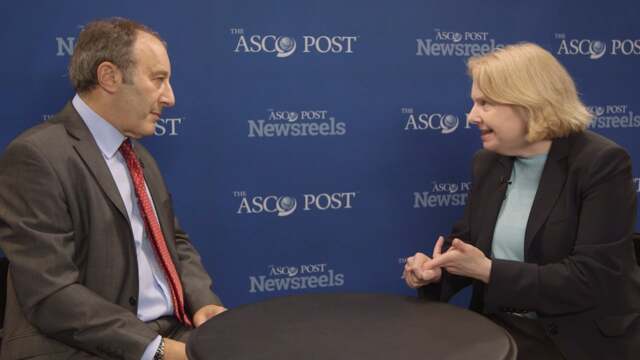
Martin J. Van Den Bent, MD, PhD, on Anaplastic Glioma: Results from the CATNON Trial
2016 ASCO Annual Meeting
Martin J. Van Den Bent, MD, PhD, of the Daniel den Hoed Cancer Center, discusses the interim analysis of the EORTC phase III study on concurrent and adjuvant temozolomide in anaplastic glioma without 1p/19q co-deletion (Abstract LBA2000).
Anthony J. Olszanski, RPh, MD, of Fox Chase Cancer Center, and Michael A. Davies, MD, PhD, of the University of Texas MD Anderson Cancer Center, discuss this phase III study of dabrafenib plus trametinib vs dabrafenib monotherapy in patients with unresectable or metastatic BRAF V600E/K-mutant cutaneous melanoma (Abstract 9502).
Heinz-Josef Lenz, MD, of the University of Southern California, and Jonathan R. Strosberg, MD, of the H. Lee Moffitt Cancer Center and Research Institute, discuss efficacy and safety results in patients with midgut neuroendocrine tumors treated with lutetium Lu-177 dotatate (Abstract 4005).
Helen MacKay, MD, of the Sunnybrook Odette Cancer Centre, discusses findings from this phase II study of intraperitoneal vs intravenous chemotherapy following neoadjuvant chemotherapy and optimal debulking surgery in patients with epithelial ovarian cancer (Abstract LBA5503).
Julie R. Park, MD, of Seattle Children’s Hospital, discusses findings from this phase III trial of tandem myeloablative autologous stem cell transplant using peripheral blood stem cell as consolidation therapy for high-risk neuroblastoma (Abstract LBA3).
The
Jonathan A. Ledermann, MD, of Cancer Research UK and University College London Cancer Trials Centre, and Ursula A. Matulonis, MD, of the Dana-Farber Cancer Institute, discuss findings on overall survival in patients with platinum-sensitive relapsed serous ovarian cancer receiving olaparib maintenance monotherapy (Abstract 5501).