Heinz-Josef Lenz, MD, and Jonathan R. Strosberg, MD, on the NETTER-1 Trial for Midgut Neuroendocrine Tumors
2016 ASCO Annual Meeting
Heinz-Josef Lenz, MD, of the University of Southern California, and Jonathan R. Strosberg, MD, of the H. Lee Moffitt Cancer Center and Research Institute, discuss efficacy and safety results in patients with midgut neuroendocrine tumors treated with lutetium Lu-177 dotatate (Abstract 4005).
Nagi S. El-Saghir, MD, of the American University of Beirut, and Mary Gospodarowicz, MD, of the Princess Margaret Hospital, discuss oncology from an international point of view.
Rakesh Chopra, MD, of the Artemis Health Institute, and Mary Gospodarowicz, MD, of Princess Margaret Hospital, discuss oncology from an international point of view.
James Kochenderfer, MD, of the National Cancer Institute, discuss results of a small study on genetically modified CAR-T cells, which may well become a standard lymphoma treatment (Abstract LBA3010).
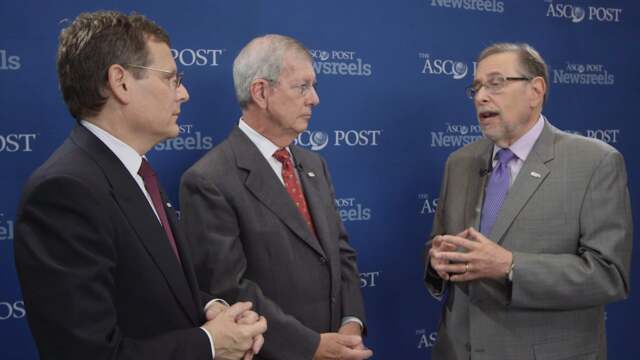
Richard L. Schilsky, MD (right), Chief Medical Officer of ASCO, talks with incoming ASCO CEO Clifford A. Hudis, MD (left) and outgoing CEO Allen S. Lichter, MD (center) about the passing of the torch and their perspectives on past accomplishments and future goals of the society.
Luis G. Paz-Ares, MD, PhD, of the Hospital Universitario 12 De Octubre, discusses in Spanish study findings on adding necitumumab to gemcitabine and cisplatin chemotherapy in the first-line treatment of patients with stage IV squamous non–small cell lung cancer.

To see the English language version of this video, please
click here.