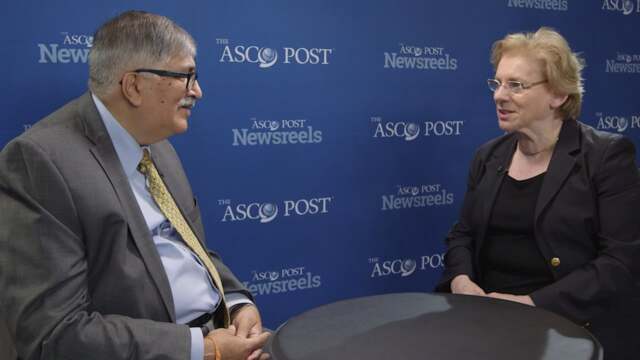
Celestia S. Higano, MD, and Chris Parker, MD, on the PROMIS Study of Elevated PSA
2016 ASCO Annual Meeting
Celestia S. Higano, MD, of the University of Washington, and Chris Parker, MD, of the Royal Marsden Hospital, discuss findings from this confirmatory study evaluating the accuracy of MRI and TRUS biopsy in men with an elevated PSA (Abstract 5000).
Sagar Lonial, MD, of Emory University School of Medicine, and Andrew D. Zelenetz, MD, PhD, of Memorial Sloan Kettering Cancer Center, discuss newly reported findings on rituximab maintenance therapy in hematologic malignancies (Abstracts 7503, 7504, and 7505).
Usha Menon, MD, of University College London, discusses a significant new version of a screening test for ovarian cancer that may reduce death from the disease (Abstract 5507).
A. Oliver Sartor, MD, of Tulane University, and Celestia S. Higano, MD, of the University of Washington, discuss findings from this phase III study on cabazitaxel vs docetaxel in chemotherapy-naive patients with metastatic castration-resistant prostate cancer (Abstract 5006).
Vali A. Papadimitrakopoulou, MD, of MD Anderson Cancer Center, and Fabrice Denis, MD, PhD, of the Institut Inter-regional de Cancérologie Jean Bernard, discuss findings from a phase III trial on an app used between visits for early detection of symptomatic relapse and complications in high-risk lung cancer patients (Abstract LBA9006). To see Dr. Denis discuss this study in French, click here.
 To see the French language version of this discussion, click here.
Rakesh Chopra, MD, of the Artemis Health Institute, and Mary Gospodarowicz, MD, of Princess Margaret Hospital, discuss oncology from an international point of view.