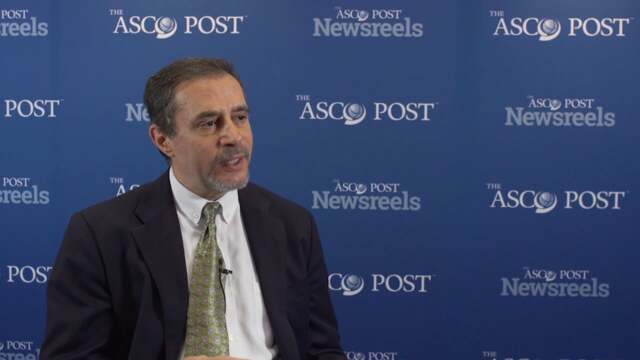
Sébastien Maury, MD, on ALL: Results of the Graall-R 2005 Study
2015 ASH Annual Meeting
Sébastien Maury, MD, of the Hôpital Henri Mondor, discusses this study in which adding rituximab improved the outcome of adult patients with CD20-positive, Ph-negative B-cell precursor acute lymphoblastic leukemia (Abstract 1). To see the French language version of this newsreel, please click here.
Kieron Dunleavy, MD
Kieron Dunleavy, MD, of the National Cancer Institute, discusses a multi-center trial that set out to validate the effectiveness of DA-EPOCH-R-based therapy and whether a risk-adapted approach using the regimen is beneficial for patients with Burkitt lymphoma (Abstract 342).
Craig H. Moskowitz, MD
Craig H. Moskowitz, MD, of Memorial Sloan Kettering Cancer Center, discusses a phase I study of an anti-CD19 monoclonal antibody used in relapsed/refactory B-lineage non-Hodgkin lymphoma (Abstract 182).
David Henry, MD
David Henry, MD, of Pennsylvania Hospital, discusses new advances with direct oral anticoagulants, or DOACs.
Andrew D. Zelenetz, MD, PhD
Andrew D. Zelenetz, MD, PhD, of Memorial Sloan Kettering Cancer Center, discusses a late-breaking abstract on the superiority of this three-drug combination compared to bendamustine and rituximab alone in patients with relapsed/refractory chronic lymphocytic leukemia (Abstract LBA5).
Hagop M. Kantarjian, MD
Hagop M. Kantarjian, MD, of MD Anderson Cancer Center, discusses a study that compared efficacy and safety results of using 5-day and 10-day regimens of a novel hypomethylating agent in 103 treatment-naïve AML patients who were not candidates for intensive chemotherapy (Abstract 458).