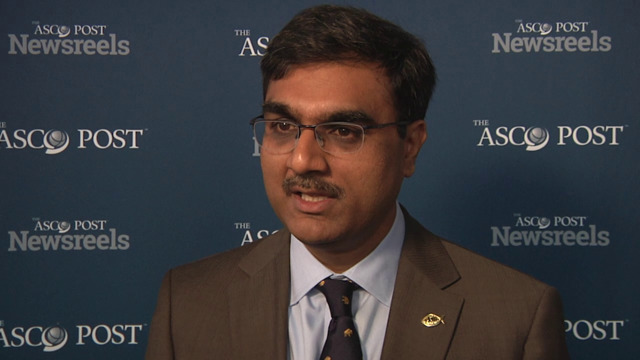
Saad Usmani, MD, on Daratumumab as Monotherapy for Multiple Myeloma
2015 ASCO Annual Meeting
For a heavily pretreated multiple myeloma population, daratumumab as a monotherapy showed meaningful, durable activity with deep responses and a favorable safety profile. Saad Usmani, MD, of the Levine Cancer Institute, provides the highlights of this study on the first monoclonal antibody to show promise in multiple myeloma (Abstract LBA8512).
Claus Garbe, MD, and Anthony J. Olszanski, RPh, MD
Claus Garbe, MD, of the University of Tuebingen, and Anthony J. Olszanski, RPh, MD, of Fox Chase Cancer Center, discuss the survival of sentinel lymph node-positive melanoma patients with and without complete lymph node dissection (Abstract LBA9002).
Richard G. Margolese, MD
Richard G. Margolese, MD, of McGill University discusses the improvement in breast cancer-free interval with anastrozole vs tamoxifen in patients with DCIS undergoing lumpectomy plus radiotherapy (Abstract LBA500).
Charles F. von Gunten, MD, PhD
Charles F. von Gunten, MD, PhD, of OhioHealth Kobacker House discusses the ROMANA 1 and 2 trials on cachexia in NSCLC and a study on olanzapine vs fosaprepitant for the prevention of nausea and vomiting (Abstracts 9500 and 9502).
Lee S. Schwartzberg, MD
Lee S. Schwartzberg, MD, of The West Clinic, describes a new initiative of the Association of Community Cancer Centers, designed to speed the adoption of immunotherapeutics in the community setting, where 60% of cancer patients are treated.
Asher Alban Chanan-Khan, MD
Asher Alban Chanan-Khan, MD, of the Mayo Clinic Cancer Center, discusses an important treatment option that significantly improved overall response rate and reduced risk of progression or death by 80% (Abstract LBA7005).