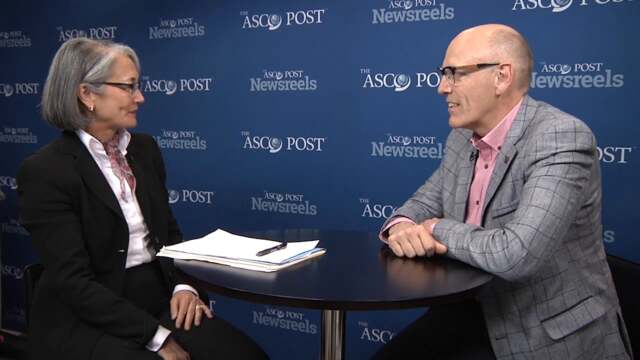
Julie Gralow, MD, and Clifford A. Hudis, MD, on Bisphosphonates as Adjuvant Therapy in Primary Breast Cancer
2015 ASCO Annual Meeting
Julie Gralow, MD, of the University of Washington/Seattle Cancer Care Alliance, and Clifford A. Hudis, MD, of Memorial Sloan Kettering Cancer Center, discuss this important SWOG trial and why oral bisphosphonates should be made available in the United States (Abstract 503).
Saad Usmani, MD
For a heavily pretreated multiple myeloma population, daratumumab as a monotherapy showed meaningful, durable activity with deep responses and a favorable safety profile. Saad Usmani, MD, of the Levine Cancer Institute, provides the highlights of this study on the first monoclonal antibody to show promise in multiple myeloma (Abstract LBA8512).
Charles F. von Gunten, MD, PhD
Charles F. von Gunten, MD, PhD, of OhioHealth Kobacker House discusses the ROMANA 1 and 2 trials on cachexia in NSCLC and a study on olanzapine vs fosaprepitant for the prevention of nausea and vomiting (Abstracts 9500 and 9502).
Gregory T. Armstrong, MD, MSCE, and Lisa Diller, MD
Lisa Diller, MD, of Dana-Farber Cancer Institute, and Gregory T. Armstrong, MD, MSCE, of St. Jude Children's Research Hospital, discuss the findings of a landmark survivorship study (Abstract LBA2).
James H. Doroshow, MD
James H. Doroshow, MD, of the National Cancer Institute, describes a new precision medicine initiative called the MATCH trial: Molecular Analysis for Therapy Choice. In 2,400 NCI clinical trial sites, 3,000 patients will be screened and their tumors analyzed to determine whether they contain genetic abnormalities for which a targeted drug exists.
Nicholas David James, MD, PhD, and Celestia S. Higano, MD
Celestia S. Higano, MD, of the University of Washington, and Nicholas David James, MD, PhD, of Warwick Medical School, discuss data showing improvements in survival from adding docetaxel in men starting long-term hormone therapy for the first time (Abstract 5001).