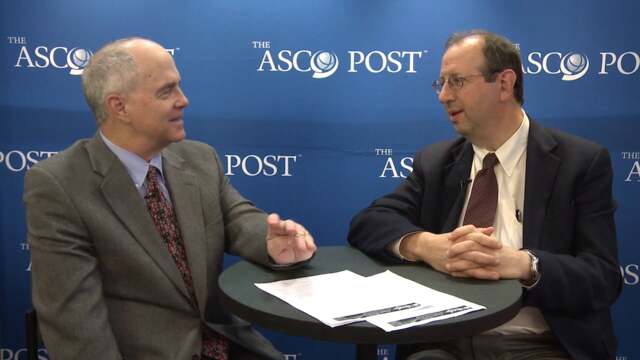
James O. Armitage, MD, FACP, FRCP, and Richard M. Stone, MD
James O. Armitage, MD, FACP, FRCP, of the University of Nebraska Medical Center, and Richard M. Stone, MD of the Dana-Farber Cancer Institute, discuss three clinical trials: different doses of daunorubicin for AML; comparing azacitidine plus lenolidomide to vorinostat vs azacitidine monotherapy in MDS and CMML; and sorafenib vs placebo in addition to standard treatment for AML.
Linda J. Burns, MD
2014 ASH President Linda J. Burns, MD, of the University of Minnesota, offers her thoughts on abstract 379, “BLAST: A Confirmatory, Single-Arm, Phase II Study of Blinatumomab, a Bispecific T-Cell Engager (BiTE) Antibody Construct, in Patients with Minimal Residual Disease B-Precursor Acute Lymphoblastic Leukemia (ALL),” presented by Nicola Gökbuget, MD.
Time: 1:11
Julie M. Vose, MD, MBA, FASCO
Julie M. Vose, MD, MBA, FASCO, of the University of Nebraska Medical Center, offers her thoughts on abstract 289, “Nivolumab in Patients With Relapsed or Refractory Hodgkin Lymphoma: Preliminary Safety, Efficacy, and Biomarker Results of a Phase I Study,” presented by Philippe Armand, MD, PhD.