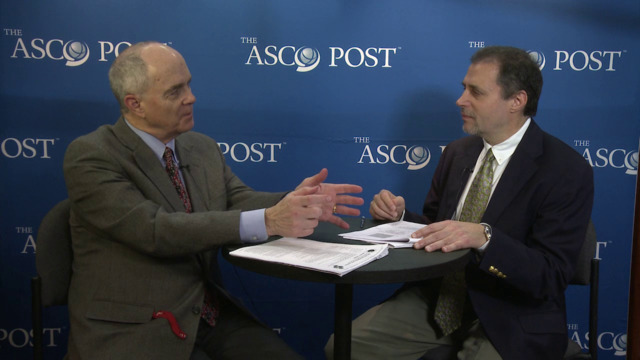
Julie M. Vose, MD, MBA, FASCO, on Nivolumab in Relapsed/Refractory Hodgkin Lymphoma
2014 ASH Annual Meeting
Julie M. Vose, MD, MBA, FASCO, of the University of Nebraska Medical Center, offers her thoughts on abstract 289, “Nivolumab in Patients With Relapsed or Refractory Hodgkin Lymphoma: Preliminary Safety, Efficacy, and Biomarker Results of a Phase I Study,” presented by Philippe Armand, MD, PhD.
Bertrand Coiffier, MD, PhD
Bertrand Coiffier, MD, PhD, of Centre Hospitalier Lyon-Sud, offers his thoughts on abstract 146, “Rituximab Maintenance vs Wait and Watch After Four Courses of R-DHAP Followed By Autologous Stem Cell Transplantation in Previously Untreated Young Patients With Mantle Cell Lymphoma: First Interim Analysis of the Phase III Prospective LyMa Trial, a Lysa Study,” presented by Steven Le Gouill, MD, PhD.
James O. Armitage, MD, FACP, FRCP, and Hagop M. Kantarjian, MD
James O. Armitage, MD, FACP, FRCP, of the University of Nebraska Medical Center, and Hagop M. Kantarjian, MD, of The University of Texas MD Anderson Cancer Center, discuss the diagnosis and genetics of ALL, differences in treating younger and older patients, and the latest data on the use of tyrosine kinase inhibitors, monoclonal antibodies, and CAR T cells.