Advertisement


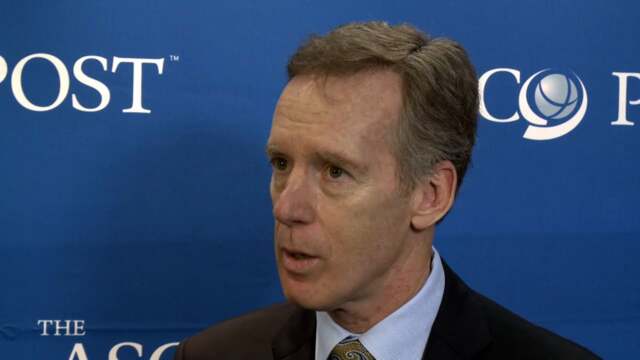
Hagop Kantarjian, MD, on Treating Philadelphia Chromosome–Positive ALL

2014 ASH Annual Meeting

Advertisement

Hagop Kantarjian, MD, of The University of Texas MD Anderson Cancer Center, offers his thoughts on abstract 797, “First Results of the Multicenter Total Therapy Gimema LAL 1509 Protocol for De Novo Adult Philadelphia Chromosome–Positive Acute Lymphoblastic Leukemia Patients,” presented by Sabina Chiaretti, MD, PhD, and abstract 798, “Nilotinib and Chemotherapy for First-Line Treatment in Elderly Patients with De Novo Philadelphia Chromosome/BCR-ABL1–Positive Acute Lymphoblastic Leukemia (ALL): A Trial of the European Working Group for Adult ALL (EWALL-PH-02),” presented by Oliver G. Ottman, MD.
Related Videos

Leukemia

James O. Armitage, MD, FACP, FRCP, and Hagop M. Kantarjian, MD, on Advances in the Treatment of ALL

James O. Armitage, MD, FACP, FRCP, of the University of Nebraska Medical Center, and Hagop M. Kantarjian, MD, of The University of Texas MD Anderson Cancer Center, discuss the diagnosis and genetics of ALL, differences in treating younger and older patients, and the latest data on the use of tyrosine kinase inhibitors, monoclonal antibodies, and CAR T cells.

Leukemia

Hagop Kantarjian, MD, on CAR T Cells in Relapsed/Refractory ALL

Hagop Kantarjian, MD, of The University of Texas MD Anderson Cancer Center, offers his thoughts on abstract 380, “T Cells Engineered with a Chimeric Antigen Receptor (CAR)-Targeting CD19 (CTL019) Have Long Term Persistence and Induce Durable Remissions in Children With Relapsed, Refractory ALL,” presented by Stephan A. Grupp, MD, PhD; abstract 381, “Intent-to-Treat Results of a Phase I Trial of CD19 Chimeric Antigen Receptor Engineered T Cells Using a Consistent Treatment Regimen Reveals a 67% Complete Response Rate in Relapsed, Refractory Acute Lymphoblastic Leukemia,” presented by Daniel W. Lee III, MD; and abstract 382, “CD19-Targeted 19-28z CAR Modified Autologous T Cells Induce High Rates of Complete Remission and Durable Responses in Adult Patients With Relapsed, Refractory B-Cell ALL,” presented by Jae H. Park, MD.

Myelodysplastic Syndromes

Alan F. List, MD, on the CC-5013-MDS-005 Study

Alan F. List, MD, of Moffitt Cancer Center, offers his thoughts on abstract 409, “Efficacy and Safety of Lenalidomide vs Placebo in RBC Transfusion–Dependent Patients With IPSS Low-/Intermediate-Risk Myelodysplastic Syndromes Without Del(5q) and Unresponsive or Refractory to Erythropoiesis-Stimulating Agents: Results From a Randomized Phase III Study (CC-5013-MDS-005),” presented by Valeria Santini, MD.

Leukemia
Myelodysplastic Syndromes

James O. Armitage, MD, FACP, FRCP, and Richard M. Stone, MD, on Clinical Trial Results for AML, MDS, and CMML Treatment

James O. Armitage, MD, FACP, FRCP, of the University of Nebraska Medical Center, and Richard M. Stone, MD of the Dana-Farber Cancer Institute, discuss three clinical trials: different doses of daunorubicin for AML; comparing azacitidine plus lenolidomide to vorinostat vs azacitidine monotherapy in MDS and CMML; and sorafenib vs placebo in addition to standard treatment for AML.

Lymphoma

Laurie Sehn, MD, on Lenalidomide Plus Rituximab in Previously Untreated Mantle Cell Lymphoma

Laurie Sehn, MD, of the BC Cancer Agency, on abstract 625, “Sustained Remission With the Combination Biologic Doublet of Lenalidomide Plus Rituximab as Initial Treatment for Mantle Cell Lymphoma: A Multicenter Phase II Study Report,” presented by Jia Ruan, MD, PhD.

Advertisement

Advertisement


Advertisement