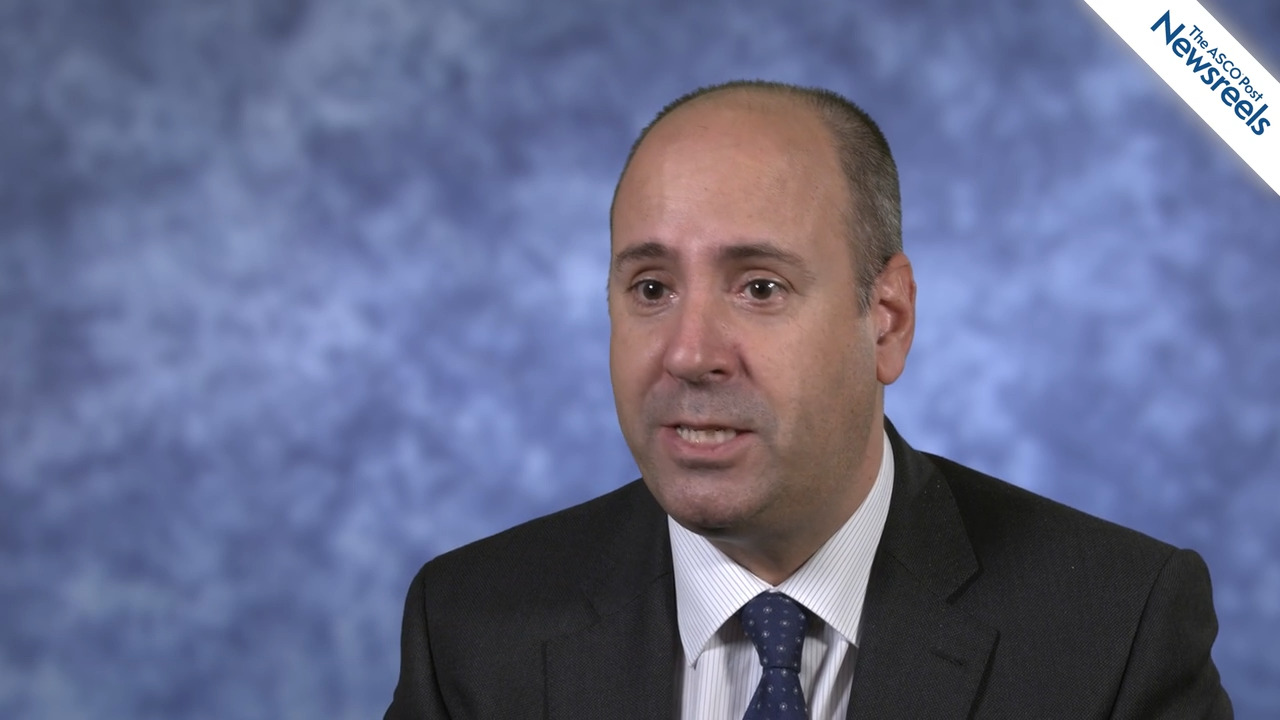
François-Clément Bidard, MD, PhD, on Metastatic Breast Cancer: Endocrine Therapy and Palbociclib
2021 San Antonio Breast Cancer Symposium
François-Clément Bidard, MD, PhD, of the Institut Curie, discusses phase III findings of the PADA-1 study, which showed that optimizing endocrine therapy after detecting the ESR1 mutation in patients with hormone receptor–positive, HER2-negative metastatic breast cancer may double their median progression-free survival (Abstract GS3-05).
The ASCO Post Staff
Meredith M. Regan, ScD, of Dana-Farber Cancer Institute, discusses findings that point to the potential benefits of using adjuvant exemestane plus ovarian function suppression (OFS) to treat premenopausal women with hormone receptor–positive early breast cancer. This conclusion came after 13 years of median follow-up on the TEXT and SOFT trials, during which this regimen was compared with tamoxifen and OFS (Abstract GS2-05).
The ASCO Post Staff
Javier Cortés, MD, PhD, of the International Breast Cancer Center, discusses the final phase III results of KEYNOTE-355, which showed that pembrolizumab and chemotherapy improved overall and progression-free survival, compared with placebo and chemotherapy, for patients with previously untreated, locally recurrent, inoperable or metastatic triple-negative breast cancer (Abstract GS1-02 ).
The ASCO Post Staff
Peter Schmid, MD, PhD, of Barts Cancer Institute, discusses phase III findings from KEYNOTE-522, in which researchers found a generally consistent event-free survival benefit among patients with early-stage high-risk triple-negative breast cancer who were treated with neoadjuvant pembrolizumab plus chemotherapy followed by adjuvant pembrolizumab (Abstract GS1-01).
The ASCO Post Staff
Lisa A. Carey, MD, of the University of North Carolina at Chapel Hill and the Lineberger Comprehensive Cancer Center, discusses findings from a pooled analysis of the MONALEESA-2, -3, and -7 trials. Among the findings was a consistent overall survival benefit with ribociclib plus endocrine therapy for patients with luminal A, luminal B, and HER2E breast cancer subtypes. Patients with the basal-like subtype did not derive a benefit from ribociclib, but the sample size was small (Abstract GS1-04).
The ASCO Post Staff
Sara A. Hurvitz, MD, of the University of California, Los Angeles Jonsson Comprehensive Cancer Center, discusses phase III findings from the DESTINY-Breast03 trial, which compared ado-trastuzumab deruxtecan (T-DXd) with standard-of-care trastuzumab emtansine (T-DM1) in patients with HER2-positive metastatic breast cancer. T-DXd showed superior progression-free survival across subgroups of patients previously treated with trastuzumab and a taxane, including those with brain metastases (Abstract GS3-01).