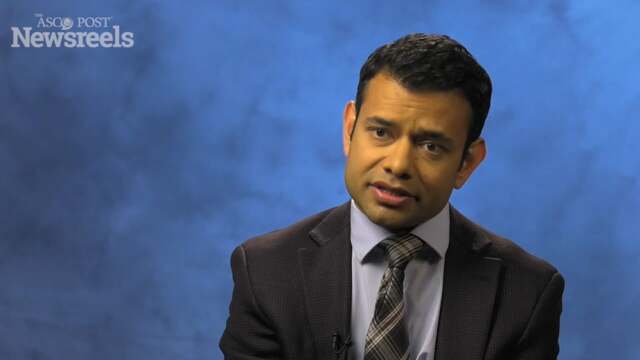
L. Michael Glodé, MD, on Prostate Cancer: Results From SWOG S9921
2017 Genitourinary Cancers Symposium
L. Michael Glodé, MD, of the University of Colorado Cancer Center, discusses study findings on adjuvant androgen deprivation vs mitoxantrone plus prednisone plus ADT in high-risk prostate cancer patients following radical prostatectomy. (Abstract 2)
Rana R. McKay, MD, of the University of California, San Diego, discusses study findings on PD-1/PD-L1 responders with metastatic renal cell carcinoma who discontinue therapy for immune-related adverse events. (Abstract 467)
Karim Chamie, MD, of the University of California, Los Angeles, discusses induction and maintenance BCG therapy in non–muscle-invasive bladder cancer.
Guru Sonpavde, MD, of the UAB Comprehensive Cancer Center, discusses his study on circulating tumor DNA alterations in metastatic castration-resistant prostate cancer and the therapeutic direction the data suggest. (Abstract 149)
Paul L. Nguyen, MD, of the Dana-Farber Cancer Institute, discuses an evaluation of the Decipher prostate cancer classifier to predict metastasis and disease-specific mortality from genomic analysis of diagnostic needle biopsy specimens. (Abstract 4)
Sumanta K. Pal, MD, of the City of Hope, discusses the evolution of circulating tumor DNA profile from first-line to second-line therapy in metastatic renal cell carcinoma. (Abstract 434)