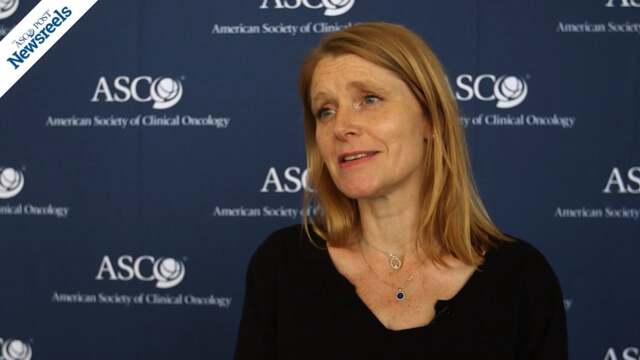
Solange Peters, MD, PhD, and Mary Gospodarowicz, MD, on Mentoring Women in Oncology: An International Perspective
2017 ASCO Annual Meeting
Solange Peters, MD, PhD, of the University of Lausanne, who has been a driving force in ESMO’s efforts to promote women in oncology, talks with Mary Gospodarowicz, MD, of Princess Margaret Hospital, a recipient of the 2017 Women Who Conquer Cancer Mentorship Award.
Arnaud Scherpereel, MD, PhD, of the University Hospital of Lille, discusses in French phase II study findings on second- or third-line nivolumab vs nivolumab plus ipilimumab in malignant pleural mesothelioma patients. (Abstract LBA8507)
Daniel Heng, MD, MPH, of the Tom Baker Cancer Centre and the University of Calgary, and Sumanta K. Pal, MD, of the City of Hope, discuss key findings presented at ASCO: adjuvant pazopanib vs placebo after nephrectomy in patients with locally advanced disease (the PROTECT Trial), and adjuvant sunitinib used to treat high-risk disease.
Sumanta K. Pal, MD, of City of Hope, and Toni K. Choueiri, MD, of the Dana-Farber Cancer Institute, exchange views on the key papers in renal cell carcinoma presented at ASCO’s 2017 nonprostate GU oral abstract session. (Abstracts 4504, 4505, 4506, 4507, 4508)
Nicholas D. James, MBBS, PhD, of Queen Elizabeth Hospital, discusses study findings on adding abiraterone for men with high-risk prostate cancer starting long-term androgen-deprivation therapy (Abstract LBA5003).
Solange Peters, MD, PhD, of the University of Lausanne, examines the study findings on nivolumab ± ipilimumab in advanced small cell lung cancer, in the first report of a randomized expansion cohort. (Abstract 8503)