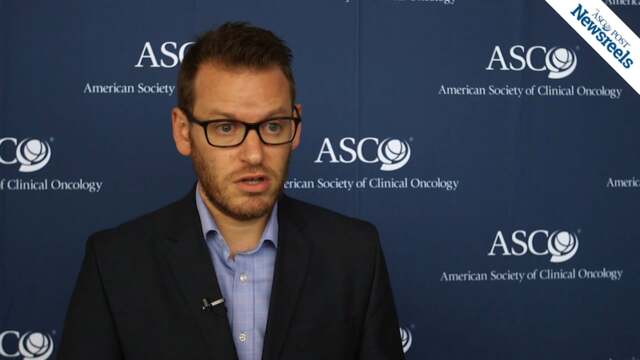
Olivier Tredan, MD, PhD, on Advanced Refractory Cancer and Molecular Screening
2017 ASCO Annual Meeting
Olivier Tredan, MD, PhD, of the Centre Léon Bérard, discusses results from ProfilER, a study that explored the use of cancer cell genomic alterations to guide treatment in patients with advanced refractory cancer. (Abstract LBA100)
Daniel Heng, MD, MPH, of the Tom Baker Cancer Centre and the University of Calgary, and Sumanta K. Pal, MD, of the City of Hope, discuss key findings presented at ASCO: adjuvant pazopanib vs placebo after nephrectomy in patients with locally advanced disease (the PROTECT Trial), and adjuvant sunitinib used to treat high-risk disease.
Lisa A. Carey, MD, of the University of North Carolina, and Richard S. Finn, MD, of UCLA Medical Center, discuss phase II overall survival findings on palbociclib in combination with letrozole vs letrozole alone for front-line treatment of ER+/HER2– advanced breast cancer. (Abstract 1001)
Sumanta K. Pal, MD, of City of Hope, and Toni K. Choueiri, MD, of the Dana-Farber Cancer Institute, exchange views on the key papers in renal cell carcinoma presented at ASCO’s 2017 nonprostate GU oral abstract session. (Abstracts 4504, 4505, 4506, 4507, 4508)
Neeraj Agarwal, MD, of Huntsman Cancer Institute, and Sumanta K. Pal, MD, of the City of Hope, examine the study findings on androgen-deprivation therapy with abiraterone acetate plus prednisone or placebos in newly diagnosed high-risk metastatic hormone-naive prostate cancer. (Abstract LBA3)
Daniel A. Goldstein, MD, of Emory University and Rabin Medical Center, discusses his study findings that show nearly $1 billion in savings when patients receive personal weight-based doses instead of a predetermined fixed dose for treatment of PD-L1-positive non–small cell lung cancer. (Abstract 9013)