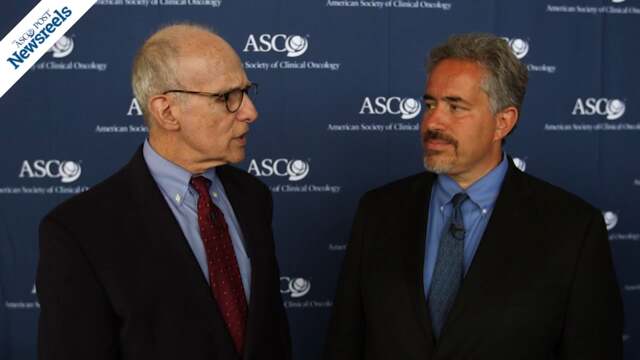
Dean F. Bajorin, MD, and Peter H. O’Donnell, MD, on Urothelial Cancer: Results From Two KEYNOTE Trials
2017 ASCO Annual Meeting
Dean F. Bajorin, MD, of Memorial Sloan Kettering Cancer Center, and Peter H. O’Donnell, MD, of The University of Chicago Medical Center, discuss their study findings on treating advanced urothelial cancer with pembrolizumab, paclitaxel, docetaxel, or vinflunine. (Abstracts 4501 and 4502)
Jame Abraham, MD, of the Cleveland Clinic, gives his views on findings on abemaciclib in combination with fulvestrant in patients with HR+/HER2- advanced breast cancer who progressed on endocrine therapy. (Abstract 1000)
Matteo Lambertini, MD, of the Institut Jules Bordet, discusses a long-term follow-up analysis of the safety of pregnancy in patients with a history of estrogen receptor–positive breast cancer. (Abstract LBA10066)
Salah-Eddin Al-Batran, MD, of the Institute of Clinical Cancer Research Krankenhaus Nordwest, discusses phase III study findings on perioperative chemotherapy with docetaxel, oxaliplatin, and fluorouracil/leucovorin vs epirubicin, cisplatin, and fluorouracil or capecitabine for resectable gastric or gastroesophageal junction adenocarcinoma. (Abstract 4004)
Gunter von Minckwitz, MD, of the German Breast Group, discusses study findings on a randomized comparison of chemotherapy, trastuzumab, and placebo vs chemotherapy, trastuzumab, and pertuzumab as adjuvant therapy in patients with HER2-positive early breast cancer. (Abstract LBA500)
David H. Henry, MD, of Pennsylvania Oncology Hematology Associates, and Ruben A. Mesa, MD, of the Mayo Clinic Cancer Center, discuss phase III study findings on momelotinib vs ruxolitinib in JAK inhibitor–naive patients with myelofibrosis. (Abstract 7000)