Inflammatory Markers and Clinical Decline After Adjuvant Chemotherapy in Older Women With Breast Cancer
As reported in the Journal of Clinical Oncology by Ji et al, the HOPE study (Hurria Older Patients [HOPE] with Breast Cancer Study) has shown that older women categorized as robust prior to adjuvant chemotherapy are at risk for clinical decline postchemotherapy, with high baseline levels of the...
Association of Breast Cancer Recurrence in Patients Achieving pCR With vs Without Residual DCIS After Neoadjuvant Chemotherapy
In a retrospective analysis from the neoadjuvant I-SPY2 trial reported in JAMA Surgery, Osdoit et al found that among patients with breast cancer achieving pathologic complete response (pCR), there were no significant differences in treatment outcomes according to the presence or absence of...
Constitutional BRCA1 Methylation and Risk of Triple-Negative Breast Cancer and Ovarian Cancer
In a case-control study within the U.S. Women’s Health Initiative (WHI) study population reported in JAMA Oncology, Lønning et al found that BRCA1 promoter methylation identified in white blood cells was associated with increased risks of incident triple-negative breast cancer and high-grade serous ...

Marleen Kok, MD, PhD, on Triple-Negative Breast Cancer: Nivolumab Monotherapy or in Combination Therapy
Marleen Kok, MD, PhD, of The Netherlands Cancer Institute in Amsterdam, discusses the initial results from the BELLINI trial, which tested whether short-term preoperative nivolumab, either as monotherapy or in combination with low-dose doxorubicin or novel immunotherapy combinations, can induce immune activation in patients with early-stage triple-negative breast cancer with tumor-infiltrating lymphocytes (Abstract LBA13).
Unhealthy Gut May Set the Stage for Breast Cancer to Spread, Preclinical Research Reveals
An unhealthy gut triggers changes in normal breast tissue that may help breast cancer metastasize, according to new, early research from the University of Virginia (UVA) Cancer Center published by Feng et al in Cancer Immunology Research. The researchers found that when the gut microbiome is...

Laurence Buisseret, MD, PhD, on Triple-Negative Breast Cancer: Chemoimmunotherapy With or Without an Anti-CD73 Antibody
Laurence Buisseret, MD, PhD, of Belgium’s Institut Jules Bordet, discusses phase II results from the SYNERGY trial, which tested first-line chemoimmunotherapy of durvalumab, paclitaxel, and carboplatin with or without the anti-CD73 antibody oleclumab in patients with advanced or metastatic triple-negative breast cancer. Although adding oleclumab to durvalumab with chemoimmunotherapy did not increase the clinical benefit rate at week 24, research is ongoing to better understand the mechanisms of response and resistance to this study combination (Abstract LBA17).
Neoadjuvant Endocrine Therapy May Elicit Differential Responses in Black vs White Women With Breast Cancer
Black women treated with neoadjuvant endocrine therapy for breast cancer were more likely to benefit than White women if treated at an earlier disease stage, but less likely to benefit than White women if treated at a later disease stage, according to results presented at the 15th American...
Reporting of Hispanic Ethnicity and Race in Breast Cancer Studies: National Cancer Database Analysis
In a National Cancer Database (NCDB) analysis reported in a research letter in JAMA Oncology, Bazan et al found that Hispanic ethnicity was reported in patient demographics or results in less than half of studies in breast cancer, with a smaller proportion categorizing race and ethnicity into...
Costs of Cancer Treatment for Younger, Privately Insured Patients
A new, large study led by researchers at the American Cancer Society (ACS) and The University of Texas MD Anderson Cancer Center showed the rising costs of cancer treatment led to increases in total costs of care, and when compounded with greater cost-sharing, increased out-of-pocket costs for...
Cost-Effectiveness of Chemotherapy Sequences in Metastatic Breast Cancer According to Prior Therapy Exposure
In a modeling study reported in the Journal of Clinical Oncology, Stephanie B. Wheeler, PhD, MPH, and colleagues identified the most cost-effective sequences of single-agent chemotherapy regimens among patients with endocrine-refractory or triple-negative metastatic breast cancer according to prior ...

Matteo Lambertini, MD, PhD, on Oncofertility Care for Young Women With Breast Cancer
Matteo Lambertini, MD, PhD, of the University of Genova and Policlinico San Martino Hospital, talks about why oncofertility counseling should now be considered mandatory in the care of young women with breast cancer. Among the treatments he recommends offering are oocyte/embryo cryopreservation (or ovarian tissue cryopreservation in those not eligible for gamete cryopreservation); ovarian suppression with gonadotropin-releasing hormone agonist during chemotherapy; and long-term follow-up to improve the management of gynecology-related issues faced by these women.
Study Explores Link Between Use of Antipsychotic Agents and Increased Breast Cancer Risk
A research team from the Centre for Safe Medication Practice and Research (CSMPR) in the Department of Pharmacology and Pharmacy at the University of Hong Kong (HKUMed) conducted a systematic review and meta-analysis of observational studies with over 2 million individuals and estimated a moderate...

Antonio Marra, MD, on Metastatic Breast Cancer: Patterns of Genomic Instability and Their Effect on Treatment
Antonio Marra, MD, of Memorial Sloan Kettering Cancer Center, discusses a mutational signature analysis that reveals patterns of genomic instability linked to resistance to endocrine therapy with or without CDK4/6 inhibition in patients with estrogen receptor–positive/HER2-negative metastatic breast cancer (Abstract 210O).
TROPiCS-02 Update: Sacituzumab Govitecan Improves Overall Survival in Previously Treated Patients With Hormone Receptor–Positive, HER2-Negative Breast Cancer
An overall survival benefit has now emerged for sacituzumab govitecan-hziy in patients with previously treated hormone receptor–positive/HER2-negative locally recurrent inoperable or metastatic breast cancer, according to a planned second interim analysis of the phase III TROPiCS-02 trial. These...
T-DXd for Patients With HER2-Low Metastatic Breast Cancer: Patient-Reported Outcomes
Patients who received fam-trastuzumab deruxtecan-nxki (T-DXd) for HER2-low metastatic breast cancer reported that the treatment maintained their quality of life compared to conventional chemotherapy, according to results presented by Ueno et al at the European Society for Medical Oncology (ESMO)...
ASCO Updated Guideline of Biomarkers in Metastatic Breast Cancer Supports PIK3CA, BRCA1/2, PD-L1 Testing
ASCO has issued a new practice guideline update on the use of biomarkers in the management of metastatic breast cancer.1 The updated guideline revisits recommendations from the 2015 guideline and addresses topics that have emerged since then in the move toward personalized medicine in metastatic...
Sacituzumab Govitecan in Pretreated Patients With Hormone Receptor–Positive, HER2-Negative Endocrine-Resistant Advanced Breast Cancer
As reported in the Journal of Clinical Oncology by Hope S. Rugo, MD, FASCO, and colleagues, the phase III TROPiCS-02 trial has shown a significant progression-free survival benefit with sacituzumab govitecan-hziy vs chemotherapy in previously treated patients with hormone receptor (HR)-positive,...
Postmarketing Colitis Cases May Be Associated With Alpelisib Use
In a research letter in JAMA Oncology, Sullivan et al described details of postmarketing cases of noninfectious colitis in patients with breast cancer reported to the U.S. Food and Drug Administration that were considered possibly or probably related to alpelisib treatment. Key Findings A total of...
Report Finds 'Batwing' Mastopexy May Enable More Women to Undergo Nipple-Sparing Mastectomy
Nipple-sparing techniques can provide better outcomes for women undergoing breast reconstruction after mastectomy, but due to complication risks, these approaches are often not offered to women with sagging or larger breasts. For this group of patients, a “batwing” incision may provide a safer...
Fertility Preservation Procedures at Breast Cancer Diagnosis: Risk of Relapse and Disease-Specific Mortality
In a Swedish nationwide prospective cohort study reported in JAMA Oncology, Marklund et al found no increased risk of relapse or disease-specific mortality among women undergoing fertility preservation with or without hormonal stimulation at the time of breast cancer diagnosis. Study Details The...
Fertility Preservation Measures Do Not Appear to Increase the Risk of Breast Cancer Recurrence
Women with a breast cancer diagnosis undergoing procedures for fertility preservation are not at an increased risk for recurrence of the disease or disease-specific mortality, according to the results of a study from the Karolinska Institutet in Sweden that followed participants for 5 years on...
Researchers Identify Markers of Chemotherapy Resistance and Outcome in Patients With Triple-Negative Breast Cancer
Researchers have identified biological markers in patients with triple-negative breast cancer that are associated with resistance to chemotherapy. The study was published by Anurag et al in the journal Cancer Discovery and was funded by the National Cancer Institute’s Clinical Proteomics Tumor...
Cancer-Related Fatigue Linked to Balance Problems After Chemotherapy for Breast Cancer
For many patients who have received chemotherapy for breast cancer, cancer-related fatigue is a persistent side effect—and one that contributes to ongoing balance problems, suggests a recent paper published by Weschler et al in Rehabilitation Oncology. The new research by Stephen Wechsler, PT, DPT, ...
APHINITY Trial in Patients With HER2-Positive Early Breast Cancer: Update at 8 Years
Updated results from the adjuvant APHINITY trial in HER2-positive early breast cancer, now with a median follow-up of 8.4 years, confirmed the benefit of adding pertuzumab to trastuzumab plus chemotherapy in preventing invasive disease recurrences, but as yet no statistically significant overall...
T-DXd Shows High Intracranial Response Rate in Patients With Active Brain Metastases From HER2-Positive Breast Cancer
In the investigator-initiated, prospective, open-label, single-arm phase II TUXEDO-1 study conducted among patients with newly diagnosed or progressive brain metastases from HER2-positive breast cancer, the antibody-drug conjugate fam-trastuzumab deruxtecan-nxki (T-DXd) yielded responses according...
WBI With Boost After Breast-Conserving Surgery in Non–Low-Risk DCIS
As reported in The Lancet by Chua et al, the phase III BIG 3-07/TROG 07.01 trial has shown reduced risk of local recurrence with vs without tumor bed boost after conventional or hypofractionated whole-breast irradiation (WBI) in women receiving breast-conserving surgery for non–low-risk ductal...
Breast Induration Risk With Partial- vs Whole-Breast Irradiation After Breast-Conserving Surgery for Node-Negative Early Disease
As reported in the Journal of Clinical Oncology by Offersen et al, the phase III Danish Breast Cancer Group Partial Breast Irradiation Trial showed that partial-breast irradiation was noninferior to whole-breast irradiation in terms of the risk for breast induration in women aged ≥ 60 years...
Locoregional Recurrence With Predefined Risk-Based De-escalation of Radiotherapy After Primary Chemotherapy in cT1–2N1 Breast Cancer
As reported in The Lancet Oncology by de Wild et al, 5-year follow-up from a Dutch prospective registry study (RAPCHEM, BOOG 2010-03) showed low rates of locoregional recurrence with de-escalation of adjuvant radiotherapy according to predefined risk levels in women receiving primary chemotherapy...
Time to Initiation of Adjuvant Endocrine Therapy and Likelihood of Adherence in Medicaid-Insured Women With Breast Cancer
In a population-based retrospective cohort study reported in JAMA Network Open, Sood et al found that longer time to adjuvant endocrine therapy initiation in Medicaid-insured women with breast cancer was associated with a reduced likelihood of short- and long-term adherence to treatment. As stated...
Nivolumab Plus T-DXd Under Study in HER2-Expressing Metastatic Breast Cancer
In the phase Ib DS8201-A-U105 trial, the addition of the PD-1 inhibitor nivolumab to the antibody-drug conjugate fam-trastuzumab deruxtecan-nxki (T-DXd) did not appear to improve outcomes over T-DXd alone (based on historical controls). However, it did establish the safety of the combination,...
FDA Approves First Targeted Therapy for HER2-Low Breast Cancer
On August 5, 2022, the U.S. Food and Drug Administration (FDA) approved fam-trastuzumab deruxtecan-nxki (T-DXd, Enhertu), an intravenous infusion for the treatment of patients with unresectable or metastatic HER2-low breast cancer. This is the first approved therapy targeted to patients with the...
Long-Term Outcomes With Adjuvant Goserelin and Tamoxifen in Premenopausal Estrogen Receptor–Positive Breast Cancer
As reported in the Journal of Clinical Oncology by Johansson et al, 20-year follow-up of the Stockholm trial (STO-5) has shown long-term reduction in the risk of distant recurrence with 2 years of adjuvant endocrine therapy with goserelin and tamoxifen vs no endocrine therapy in premenopausal women ...
Study Could Lead to Better Education and Treatment of Sexual Health for Patients With Breast Cancer
A study released by the University of Colorado Cancer Center showed that more than 70% of patients with breast cancer have reported changes that affect their sexual health during and beyond treatment. The study was published by Huynh et al in the Annals of Surgical Oncology. Study Background “More...
Patients With Triple-Negative Breast Cancer Benefited From Presurgical Immunotherapy, Regardless of Race
Black women are twice as likely to be diagnosed with triple-negative breast cancer compared with White women, 28% more likely to die from the disease than White women, and are less likely to be treated with surgery and chemotherapy, according to a study published in 2021. Despite these statistics,...
Oral Paclitaxel Plus P-Glycoprotein Pump Inhibitor Encequidar vs Intravenous Paclitaxel in Metastatic Breast Cancer
In a Latin American phase III trial reported in the Journal of Clinical Oncology, Hope S. Rugo, MD, and colleagues found that oral paclitaxel with the P-glycoprotein pump inhibitor encequidar produced a higher response rate and trends toward better survival outcomes vs intravenous (IV) paclitaxel...
KEYNOTE-355: Overall Survival With the Addition of Pembrolizumab to Chemotherapy in Advanced Triple-Negative Breast Cancer
As reported in The New England Journal of Medicine by Javier Cortés, MD, PhD, and colleagues, the phase III KEYNOTE-355 trial has shown improved overall survival with the addition of pembrolizumab to chemotherapy in previously untreated patients with advanced triple-negative breast cancer with a...
PALOMA-2: No Overall Survival Benefit Reported With Palbociclib/Letrozole in Advanced Breast Cancer
The final overall survival analysis of the phase III PALOMA-2 trial has shown no significant benefit for palbociclib given with letrozole, vs letrozole and placebo, as a first-line treatment in hormone receptor–positive, HER2-negative metastatic breast cancer.1 The results were reported at the 2022 ...
ASCO Guideline Update Supports New Second- and Third-Line Treatments for HER2-Positive Breast Cancer
ASCO has issued a new practice guideline update on the use of systemic therapy for HER2-positive breast cancer, just 4 years after the previous practice guideline update was released in 2018.1,2 This latest update reviews results from multiple clinical trials published between 2016 and 2021 that...
Study Finds Radiation Therapy May Be Safely Omitted for Some Older Patients With Luminal A Breast Cancer
For some patients aged 55 or older with early-stage, low-risk breast cancer, endocrine therapy following breast-conserving surgery may be sufficient without the need for postoperative radiation therapy, according to the results of the prospective LUMINA trial, reported at the 2022 ASCO Annual...
Changing the Natural History of ER-Positive, HER2-Negative Breast Cancer With the Introduction of CDK4/6 Inhibition
It has been 14 years since a collaboration between the University of California, Los Angeles (UCLA) and Pfizer identified a unique role for cyclin-dependent kinase 4/6 (CDK4/6) inhibitors in estrogen receptor (ER)-positive human cell line models and demonstrated that these agents act...
Does Disclosing Maternal Status Affect Children’s Health Behaviors?
Telling children about their mother’s risk of hereditary breast and/or ovarian cancer does not adversely influence the offspring’s lifestyle or quality of life in the long term, according to a new study published by McDonnell et al in the journal Pediatrics. The study looked at the mutation status...
Time-Restricted Eating Intervention Reduces Cardiovascular Risk in Older Breast Cancer Survivors
In a Canadian single-institution feasibility study reported in JACC: CardioOncology, Amy A. Kirkham, PhD, of the University of Toronto, and colleagues found that a time-restricted eating intervention reduced cardiovascular risk among older breast cancer survivors with risk factors for...
Addition of Ribociclib to Letrozole Improves Survival in Women With HR-Positive, HER2-Negative Advanced Breast Cancer
As reported in The New England Journal of Medicine by Gabriel N. Hortobagyi, MD, of the Department of Breast Medical Oncology, MD Anderson Cancer Center, Houston, and colleagues, the protocol-specified final overall survival analysis of the phase III MONALEESA-2 trial has shown a significant...
Use of Menopausal Hormone Therapy and Breast Cancer Mortality
Although aromatase inhibitors are effective in reducing estrogen levels and the risk of cancer recurrence in women diagnosed with hormone receptor–positive breast cancer, they can also cause myriad side effects, including genitourinary problems associated with menopause such as vaginal dryness,...

HER2-Positive Residual Disease
This is Part 4 of Updates in HER2-Positive Breast Cancer, a four-part video roundtable series. Scroll down to watch the other videos from this Roundtable. In this video, Drs. Carey K. Anders, Erika Hamilton, and Sara A. Hurvitz discuss the management of HER2-positive residual disease. The patient is a 39-year-old premenopausal woman who is diagnosed with T2 N1 ER/PR-negative, HER2-positive breast cancer. She goes on to receive docetaxel/carboplatin/trastuzumab/pertuzumab for 6 cycles, but at surgery she is found to have T1c and N0 residual disease. The faculty discuss strategies to prevent recurrence in patients with residual disease, reviewing the findings of the KATHERINE trial of trastuzumab vs ado-trastuzumab emtansine. They also explore strategies to prevent CNS recurrence and review upcoming trials.

HER2-Positive Early-Stage Breast Cancer
This is Part 3 of Updates in HER2-Positive Breast Cancer, a four-part video roundtable series. Scroll down to watch the other videos from this Roundtable. In this video, Drs. Carey K. Anders, Erika Hamilton, and Sara A. Hurvitz discuss the management of HER2-positive early-stage breast cancer. The patient is a 63-year-old woman with a T1c N0, ER/PR-positive, HER2-positive invasive ductal carcinoma. The faculty discuss results of the APT study and 7-year follow-up of the BCIRG-006 study, highlighting de-escalation strategies that balance the risk of recurrence with risk of side effects. They also touch on financial toxicity concerns, and the role of biosimilars in overcoming this challenge.

Metastatic HER2-Positive Breast Cancer With Brain Metastases
This is Part 2 of Updates in HER2-Positive Breast Cancer, a four-part video roundtable series. Scroll down to watch the other videos from this Roundtable. In this video, Drs. Carey K. Anders, Erika Hamilton, and Sara A. Hurvitz discuss the management of metastatic HER2-positive breast cancer with brain metastases. The patient is a 46-year-old woman with a history of de novo ER/PR-negative, HER2-positive breast cancer with liver metastases. Her hepatomegaly resolves and liver metastases improve after 6 cycles of docetaxel/trastuzumab/pertuzumab, but during routine restaging scans she is found to have progression in the liver and the brain. The faculty discuss the clinical implications of two phase III studies in patients with breast cancer brain metastases: HER2CLIMB, which evaluated the addition of tucatinib to trastuzumab and capecitabine, and DESTINY-Breast03, which compared fam-trastuzumab deruxtecan-nxki to ado-trastuzumab emtansine.
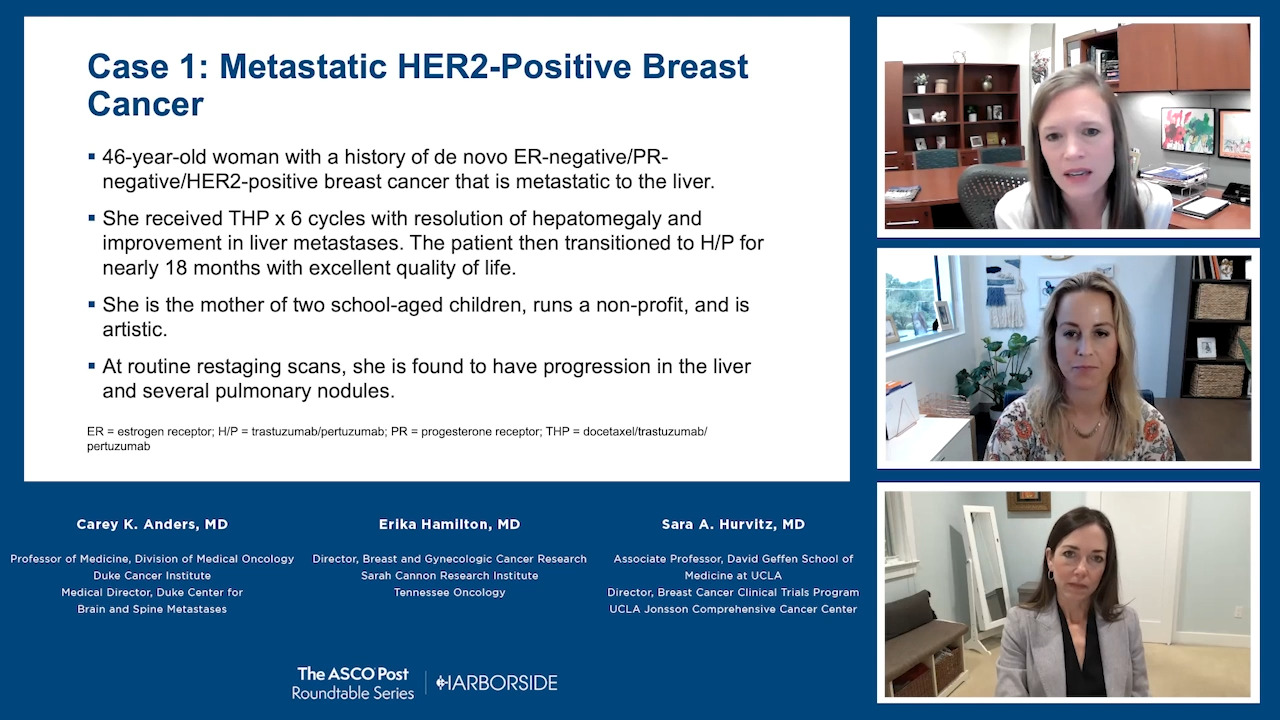
Metastatic HER2-Positive Breast Cancer
This is Part 1 of Updates in HER2-Positive Breast Cancer, a four-part video roundtable series. Scroll down to watch the other videos from this Roundtable. In this video, Drs. Carey K. Anders, Erika Hamilton, and Sara A. Hurvitz discuss the management of metastatic HER2-positive breast cancer. The patient is a 46-year-old woman with a history of de novo ER/PR-negative, HER2-positive breast cancer with liver metastases. Her hepatomegaly resolves and liver metastases improve after 6 cycles of docetaxel/trastuzumab/pertuzumab, but during routine restaging scans she is found to have progression in the liver and several pulmonary nodules. In light of this case, the faculty review the findings of the recent phase III DESTINY-Breast03 trial, which evaluated fam-trastuzumab deruxtecan-nxki in the second-line setting, and emphasize the importance of monitoring for metastatic disease while on dual antibody therapy. Additional antibody-drug conjugates currently in development are also discussed.
Addition of Atezolizumab to Neoadjuvant Pertuzumab/Trastuzumab and Docetaxel in HER2-Positive Early Breast Cancer
In the Korean phase II Neo-PATH trial reported in JAMA Oncology, Ahn et al found that neoadjuvant treatment with atezolizumab, pertuzumab/trastuzumab, and docetaxel produced a pathologic complete response in 61% of patients with HER2-positive stage II/III breast cancer treated with the regimen....
ASCO Guideline Update Aims to Improve Patient Outcomes for HER2-Positive Breast Cancer With Brain Metastases
Rapid developments over the past decade in the treatment of patients with advanced HER2-positive breast cancer may lead to better outcomes and improved quality of life for patients with brain metastases, according to findings incorporated into a new ASCO guideline update.1 “The difference this...
