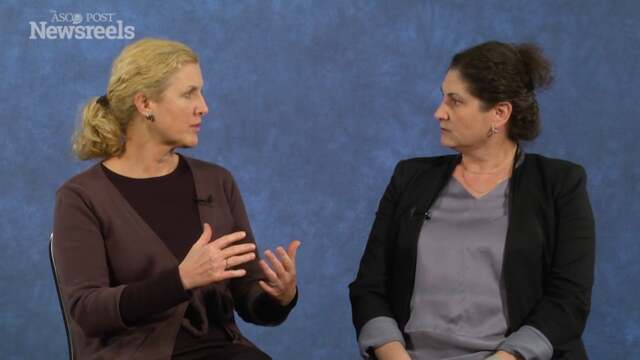
Ruth O’Regan, MD, and Ann H. Partridge, MD, on HER2+ Breast Cancer: Results From the CLEOPATRA Trial
2016 San Antonio Breast Cancer Symposium
Ruth O’Regan, MD, of the University of Wisconsin, and Ann H. Partridge, MD, of the Dana-Farber Cancer Institute, discuss study findings on the prognostic associations of TILs in metastatic HER2-positive breast cancer (Abstract S1-04).
Nikhil Wagle, MD, Dana-Farber Cancer Institute, discusses the genomic sequencing of ER-positive metastatic breast cancer that has become resistant to therapies and the implications for the choice of next therapy, clinical trial eligibility, and novel drug targets (Abstract S1-01).
Mothaffar Rimawi, MD, of the Smith Breast Center at Baylor College of Medicine, discusses phase II findings from a study evaluating pathologic complete response in patients with HR-positive, HER2-positive disease treated with neoadjuvant docetaxel, carboplatin, trastuzumab, and pertuzumab with or without estrogen deprivation (Abstract S3-06).
S.P. Somashekhar, MBBS, MCh(Onco), of the Manipal Comprehensive Cancer Centre, discusses a study to assess the performance of IBM's artificial intelligence platform in comparison to a multidisciplinary tumor board (Abstract S6-07).
Matthew P. Goetz, MD, of the Mayo Clinic, reviews progress made during the past year on treatment of advanced disease.
Lisa A. Carey, MD, of the University of North Carolina, and Ingrid A. Mayer, MD, of the Vanderbilt-Ingram Cancer Center, discuss the current studies on neoadjuvant systemic treatment in the triple-negative disease setting.