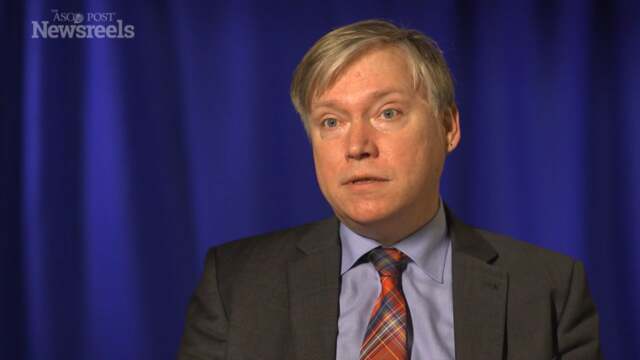
Philippe Rochigneux, MD, on Solid Tumors: Use of Chemotherapy Near End of Life (French Language Version) 
2016 ESMO Congress
Philippe Rochigneux, MD, of the Paoli Calmettes Institute, Marseille Cancer Center, discusses in French his findings on the high rates of chemotherapy used at the end of life for metastatic solid cancer, especially in young patients treated in high-volume centers without a palliative care unit. (Abstract 1300O)
The ASCO Post
Teresa Calimeri, MD, PhD, of San Raffaele Hospital, discusses in Italian high-dose methotrexate as a CNS prophylaxis, shown to significantly improve outcome in patients with high-risk diffuse large B-cell lymphoma. (Abstract 908O)
Martin Reck, MD, PhD, of the LungenClinic, discusses in German study findings on pembrolizumab vs platinum-based chemotherapy as first-line therapy for advanced non-small cell lung cancer with a PD-L1 tumor proportion score ≥50%. (Abstract LBA8)
Katja Weisel, MD, of the University of Tübingen, discusses study findings on daratumumab, bortezomib, and dexamethasone vs bortezomib and dexamethasone in patients with relapsed or refractory multiple myeloma. (Abstract 906O)
Ezra E.W. Cohen, MD, of the University of California, San Diego, discusses study findings on chemotherapy plus cetuximab in combination with motolimod immunotherapy in patients with recurrent or metastatic squamous cell carcinoma of the head and neck. (Abstract LBA37)
Martin Reck, MD, PhD, of the LungenClinic, discusses study findings on pembrolizumab vs platinum-based chemotherapy as first-line therapy for advanced non-small cell lung cancer with a PD-L1 tumor proportion score ≥50%. (Abstract LBA8)