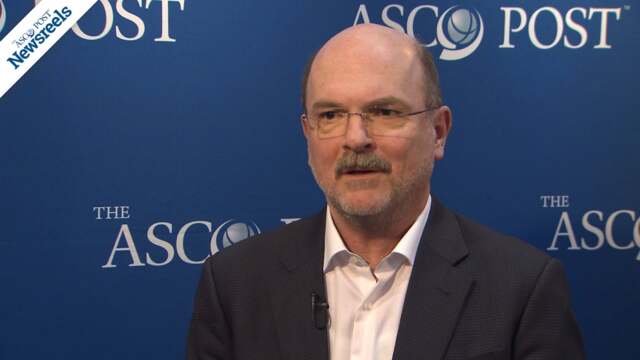
Terry J. Fry, MD, on ALL: MRD and CAR Therapy
2016 ASH Annual Meeting & Exposition
Terry J. Fry, MD, of the Pediatric Oncology Branch of the National Cancer Institute, discusses minimal residual disease–negative complete remissions following anti-CD22 chimeric antigen receptor in children and young adults with relapsed/refractory acute lymphoblastic leukemia (Abstract 650).
Stephen M. Ansell, MD, PhD, of the Mayo Clinic, discusses phase I study findings on nivolumab in combination with ipilimumab for relapsed or refractory disease (Abstract 183).
Andrew D. Zelenetz, MD, of the Memorial Sloan Kettering Cancer Center, discusses novel treatments for chronic lymphocytic leukemia, touching specifically on the Gilead 115 trial.
Robert E. Marcus, MD, of Kings College Hospital, discusses study findings on obinutuzumab-based induction and maintenance in patients with previously untreated disease (Abstract 6).
Laurie H. Sehn, MD, MPH, of the British Columbia Cancer Agency, discusses agents in the pipeline for follicular lymphoma, including drugs targeting the immune microenvironment, novel monoclonal antibodies, and emerging immunotherapeutics.
Martin Schrappe, MD, of Christian-Albrechts University Kiel, discusses study findings on reduced intensity delayed intensification in standard-risk patients defined by minimal residual disease in childhood acute lymphoblastic leukemia (Abstract 4).