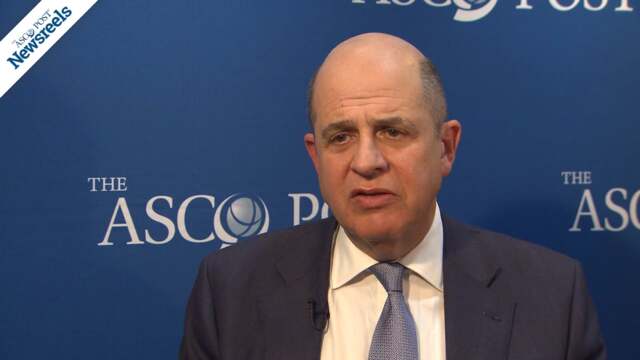
Martin Schrappe, MD, on Childhood ALL: Study Results on Reducing Treatment Burden (German Language Version) 
2016 ASH Annual Meeting & Exposition
Martin Schrappe, MD, of Christian-Albrechts University Kiel, discusses in German study findings on reduced intensity delayed intensification in standard-risk patients defined by minimal residual disease in childhood acute lymphoblastic leukemia (Abstract 4).
Brenda M. Sandmaier, MD, of Fred Hutchinson Cancer Research Center, and Sagar Lonial, MD, of Emory University, discuss study findings on sirolimus combined with mycophenolate mofetil and cyclosporine to improve prevention of acute graft-vs-host-disease after unrelated hematopoietic cell transplantation (Abstract 506).
Jeffrey E. Lancet, MD, of the H. Lee Moffitt Cancer Center and Research Institute, discusses study findings on survival following allogeneic hematopoietic cell transplantation in older, high-risk acute myeloid leukemia patients initially treated with CPX-351 liposome injection vs standard cytarabine and daunorubicin (Abstract 906).
Martin Schrappe, MD, of Christian-Albrechts University Kiel, discusses study findings on reduced intensity delayed intensification in standard-risk patients defined by minimal residual disease in childhood acute lymphoblastic leukemia (Abstract 4).
Steven Le Gouill, MD, PhD, of Nantes University Hospital and INSERM, discusses study findings from the Lysa/Goelams Group on rituximab maintenance after autologous stem cell transplantation in younger patients with mantle cell lymphoma (Abstract 145).
Robert E. Marcus, MD, of Kings College Hospital, discusses study findings on obinutuzumab-based induction and maintenance in patients with previously untreated disease (Abstract 6).