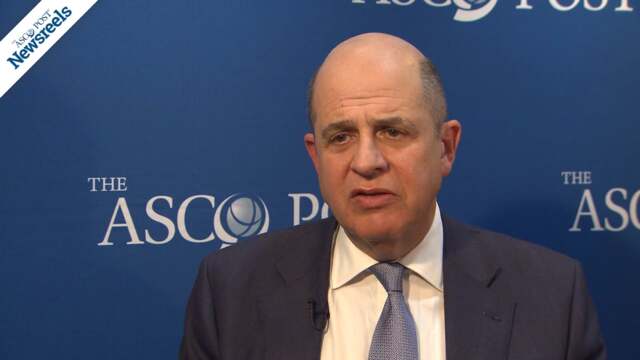
Harry P. Erba, MD, PhD, on AML: Early Study Results on Vadastuximab Talirine
2016 ASH Annual Meeting & Exposition
Harry P. Erba, MD, PhD, of the University of Alabama at Birmingham, discusses phase Ib findings on vadastuximab talirine in combination with 7+3 induction therapy for patients with newly diagnosed AML (Abstract 211).
Joshua Brody, MD, of the Icahn School of Medicine at Mount Sinai, summarizes important data on passive and active immunotherapy (Abstracts 1213, 1214, 1215, 1216, 1217, 1218).
Catherine Thieblemont, MD, PhD, of Hôpital Saint-Louis and INSERM, discusses in French phase III trial findings on lenalidomide maintenance in elderly patients with DLBCL treated with R-CHOP in the first-line setting (Abstract 471).
Jose F. Leis, MD, PhD, of the Mayo Clinic, and Sagar Lonial, MD, of Emory University, discuss a session on CLL treatment (excluding transplantation): ibrutinib resistance, transformation, and cellular therapy.
Julie Vose, MD, MBA, of the University of Nebraska Medical Center, and Mhairi Copland, MB, ChB, PhD, of the Paul O’Gorman Leukaemia Research Centre at the University of Glasgow, discuss decreasing the dose of tyrosine kinase inhibitors in CML patients with stable molecular responses (Abstract 938).
Robert E. Marcus, MD, of Kings College Hospital, discusses study findings on obinutuzumab-based induction and maintenance in patients with previously untreated disease (Abstract 6).