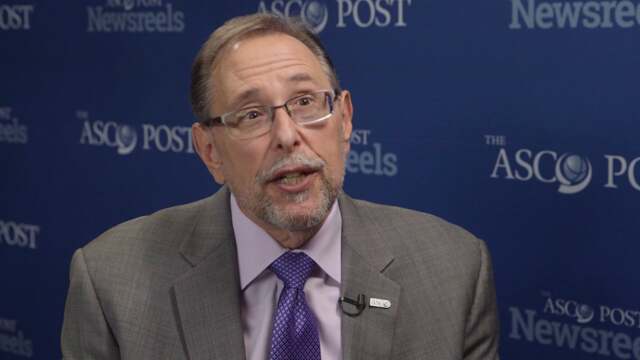
Patricia J. Goldsmith on Patient Access and Engagement: Results of the CancerCare Report
2016 ASCO Annual Meeting
Patricia J. Goldsmith, Chief Executive Officer of CancerCare, which provides free, professional support services to anyone affected by cancer, discusses findings from six distinct surveys with input from more than 3,000 individuals at varying stages of their cancer experience.
Eric Roeland, MD, of the University of California, San Diego, and Timothy E. Quill, MD, of the University of Rochester Medical Center, discuss the debate on whether physician-assisted death should be a legally available option at the end of life when neither palliative nor hospice care is satisfactory.
Eric Roeland, MD, of the University of California, San Diego, and Linda Van Le, MD, of the University of North Carolina discuss ways to manage symptoms that affect up to 80% of postmenopausal women, diminishing their quality of life.
Michael J. Overman, MD, of the University of Texas MD Anderson Cancer Center, and John Marshall, MD, of Georgetown University Lombardi Comprehensive Cancer Center, discuss interim findings on nivolumab with or without ipilimumab in the treatment of patients with metastatic colorectal cancer with and without high microsatellite instability (Abstract 3501).
John D. Hainsworth, MD, of the Sarah Cannon Research Institute, discusses early findings from this umbrella basket study on targeted treatment, outside of current drug indications, for different types of advanced solid tumors (Abstract LBA11511).
Richard L. Schilsky, MD, ASCO’s Chief Medical Officer, discusses the key presentations at this year’s conference.