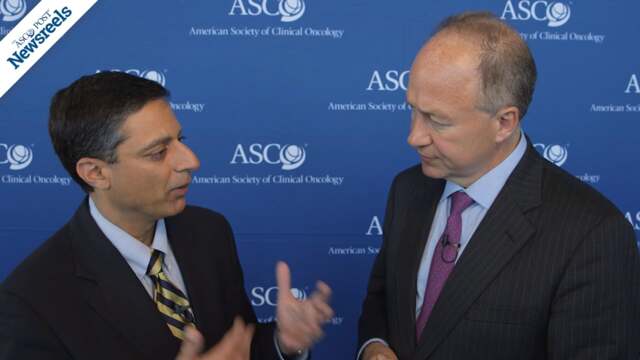
Anthony J. Olszanski, RPh, MD, and Caroline Robert, MD, PhD, on Results From the KEYNOTE-001 Melanoma Trial
2016 ASCO Annual Meeting
Anthony J. Olszanski, RPh, MD, of Fox Chase Cancer Center, and Caroline Robert, MD, PhD, of Gustave Roussy and Paris-Sud University, discuss study findings on pembrolizumab and the overall survival benefit for patients with advanced disease (Abstract 9503).
Alan Venook, MD, of the University of California, San Francisco, and John Marshall, MD, of the Lombardi Cancer Center at Georgetown University, discuss the impact of primary tumor location on overall survival and progression-free survival in patients with advanced disease (Abstract 3504).
The
Helen MacKay, MD, of the Sunnybrook Odette Cancer Centre, and Ursula A. Matulonis, MD, of Dana-Farber Cancer Institute, discuss findings from this phase II study of intraperitoneal vs intravenous chemotherapy following neoadjuvant chemotherapy and optimal debulking surgery in patients with epithelial ovarian cancer (Abstract LBA5503).
Sagar Lonial, MD, of Emory University School of Medicine, and Andrew D. Zelenetz, MD, PhD, of Memorial Sloan Kettering Cancer Center, discuss newly reported findings on rituximab maintenance therapy in hematologic malignancies (Abstracts 7503, 7504, and 7505).
Paul E. Goss, MD, PhD, of Massachusetts General Hospital Cancer Center and Harvard Medical School, discusses disease-free survival results from a study extending adjuvant letrozole for 5 years after completing an initial 5 years of aromatase inhibitor therapy alone or preceded by tamoxifen (Abstract LBA1).
Sagar Lonial, MD, of Emory University School of Medicine, and Paul G. Richardson, MD, of the Dana-Farber Cancer Institute, discuss the top presentations on multiple myeloma delivered at this year’s meeting.