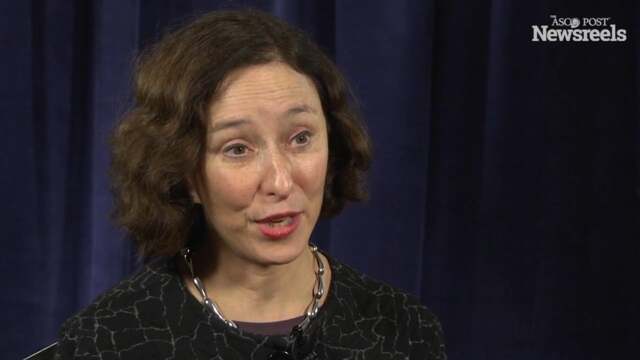
Matthew J. Ellis, PhD, FRCP: Update on Translational Research
2015 San Antonio Breast Cancer Symposium
Matthew J. Ellis, PhD, FRCP, of the Baylor College of Medicine, gives his expert perspective on this evolving area of research.
Lisa A. Carey, MD, and Jay Harris, MD
Lisa A. Carey, MD, of the University of North Carolina, and Jay Harris, MD, of Dana-Farber Cancer Institute and Brigham and Women’s Hospital, discuss Dr. Harris' plenary lecture.
Sherene Loi, MD
Sherene Loi, MD, of Peter MacCallum Cancer Centre, discusses a pooled individual patient data analysis of stromal tumor-infiltrating lymphocytes in primary triple-negative breast cancer treated with anthracycline-based chemotherapy (Abstract S1-03).
William M. Sikov, MD
William M. Sikov, MD, of Women and Infants Hospital of Rhode Island, discusses the results of this study that showed pathologic complete response to presurgery chemotherapy improved survival (Abstract S2-05).
Lisa A. Carey, MD, and Kathy S. Albain, MD
Lisa A. Carey, MD, of the University of North Carolina, and Kathy S. Albain, MD, of Loyola University Medical Center, discuss molecular predictors of outcome on adjuvant CAF plus tamoxifen, vs tamoxifen in postmenopausal patients with estrogen receptor–positive, node-positive breast cancer (Abstract S3-02).
Judy E. Garber, MD, MPH
Judy E. Garber, MD, MPH, of the Dana-Farber Cancer Institute, gives her expert perspective on this vital and timely topic.